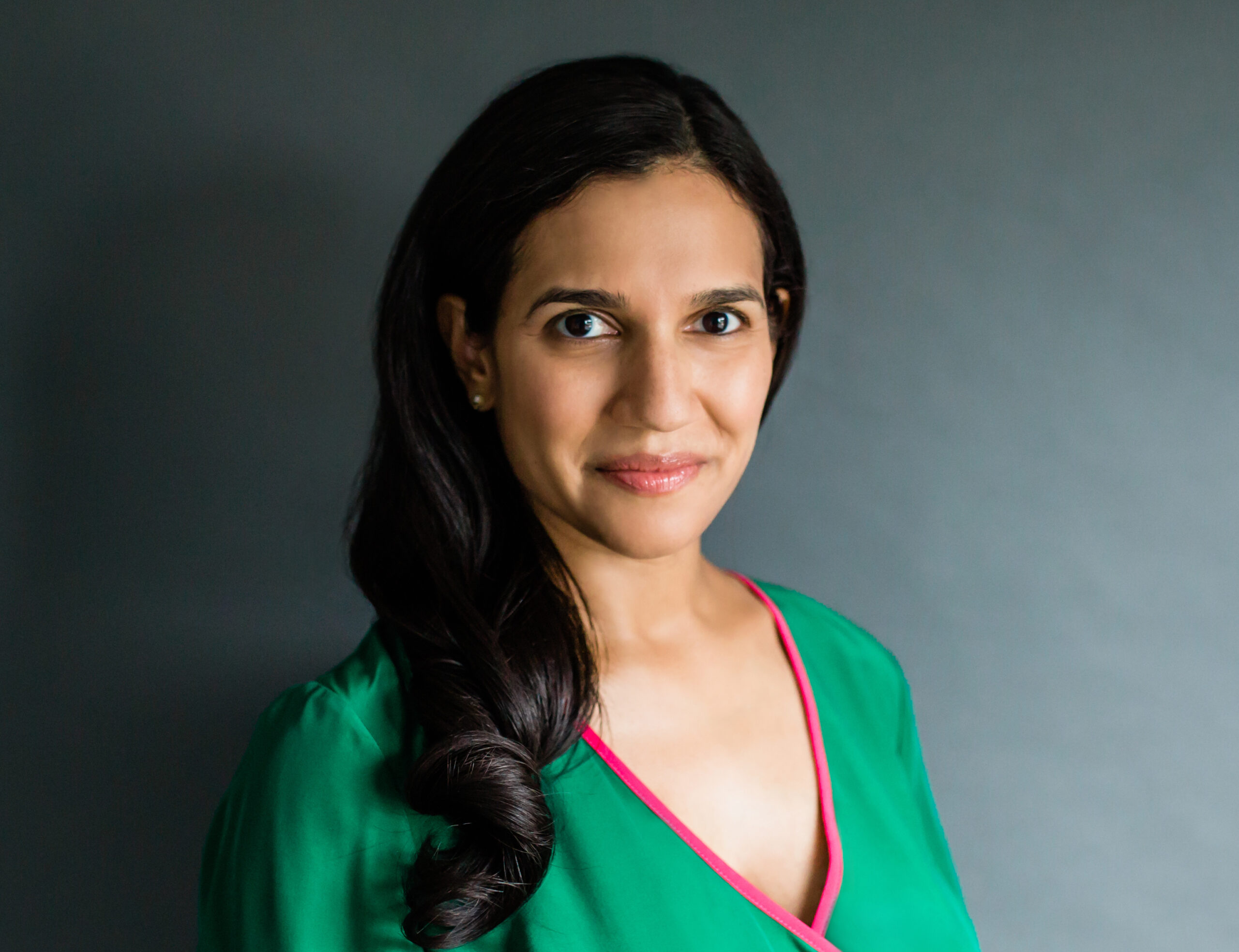
As Chief Strategy Advisor at the Global Teaching Project (GTP), Kiran Ghia tackles a complex problem with a hands-on solution, showing how each of us can give back in big and small ways. Her work takes her to the Mississippi Delta and across other rural parts of the state, where access to advanced high school coursework, particularly in STEM, is severely limited.
This inequity has significant consequences for an already disadvantaged population with limited pathways to economic mobility. Without a strong pipeline of students equipped with advanced STEM skills, the prospects for lasting economic growth and community transformation remain out of reach.
The Global Teaching Project seeks to address this issue by providing promising high school students in rural, high-poverty Mississippi communities access to advanced STEM courses they need to achieve their full potential, but which their schools otherwise may not offer, due to limited resources and a chronic, and worsening, shortage of qualified teachers. GTP works with faculty and students from Yale, the University of Virginia, Harvard, Notre Dame, Delta State, Jackson State, Ole Miss, and Mississippi State, among other leading universities, to offer Advanced Placement classes, including AP Physics, AP Biology, AP Statistics, and AP Computer Science Principles, in a blended format, which utilizes multiple means to engage and teach students. GTP also supplies laptops, lab equipment, and textbooks so students can engage fully in the courses. As Ghia puts it, there is no single fix for a problem this complex; it takes “trying a million different things to see what sticks.”
All of GTP’s programming is free to students, schools and families, and the program is currently funded entirely by private support.
Over the past ten years, GTP has worked with more than 50 schools and served over 4,000 rural Mississippi students, a deliberately select group of students, many of whom are in the top 10 percent of their class, who are likely to become the future leaders of their communities.
The roots of Ghia’s commitment to education go back to her childhood. Both of her parents, Dr. Kirti Ghia and Dr. Urmila Ghia, came to the U.S. in the 1960s as young immigrants from India, and became university professors at the University of Cincinnati; her mother in mechanical engineering and her father in aerospace engineering. She spent her Saturdays roaming the halls of the university and running around their offices, watching as they shaped generations of students.
That history shapes how Ghia sees the students she serves. She thinks of her own path as a balance beam: with a few different decisions by her grandparents, she could have ended up on the other side. The poverty that her grandparents and parents experienced in India is no different than what Mississippi’s rural population faces. “It’s just one or two decisions here and there that led to the circumstances that they were born in,” she says, “and that’s the case for any of us.”
GTP’s model is built to sustain itself, so that the community can eventually carry the work forward. Ghia points to one student from a school deep in the Delta who took AP Physics through GTP, passed the exam, and went on to Mississippi State University:
“He graduated from Mississippi State and he’s now back teaching AP Physics at Leflore High School, the same high school he once attended… this is how you do it. This is how it works, and this is how you can see a self-sustaining future.”
Although Ghia and her students come from very different worlds, she finds unexpected common ground between the Delta and India. Both regions carry a complicated history and a complex legacy, and both face systemic issues, poverty among them. But what she notices most is the people:
“It is that same warmth that you feel from people, that you feel when you go to your auntie’s house in India, right? It is the same level of warmth and comfort… They’re so different, but they’re so much alike in so many ways.”
The connection runs through the schools themselves. Indian teachers working in the Delta drive 90 minutes to the Indian grocery store in Jackson to stock up, a reminder, Ghia says, that “we’re all the same people.”
That connection is the inspiration for Ghia’s newest project, a documentary short about the Indian teachers who have come to the Delta over the last 20 years. The United States lost roughly half a million teachers during COVID, and that number has never bounced back. In rural Mississippi, where, in addition to teachers, housing and other necessities can be hard to come by, schools have recruited teachers from India to fill the gap. Walking down the science corridor of majority Black schools, Ghia would see one Indian teacher after another, from Delhi, Hyderabad, and beyond. She called a close friend, Christina MacGillivray, a filmmaker who had spent over a decade in India, and together they began developing the film, which is now in pre-production. Ghia is originally a lawyer by training, and she describes the process of getting the film off the ground as a rollercoaster of on-the-job learning, but the purpose keeps her going.
“I want so badly for our community to know what our own people are doing.”
These teachers have dedicated their careers to something that may not look glamorous but is an extremely worthy cause. The film is meant to educate the diaspora, and the country, about both the teacher shortage and the contributions of these educators.
Reflecting on this dedication to service, Ghia also credits GTP’s Founder and CEO, Matt Dolan, for reshaping her own perspective on service. “Without Matt Dolan, none of this would be possible. What he has built through the Global Teaching Project has taught me so much about serving others: namely, that we must start where the need is the greatest. Even if it’s a small corner of the world. Even if it’s hard. And even if the impact isn’t immediate.”
Finally, for Ghia, her work in rural Mississippi comes down to a question of values:
“We have an obligation, a moral obligation, and a duty to ensure that all of our children, not just in the Delta, not just in the cities, but all over the country have access to opportunity and have access to an education.”
Kiran Ghia’s story reflects what Indiaspora celebrates in the diaspora: children of immigrants who carry forward the values of their families by investing in the communities where they live, one corner of the world at a time.