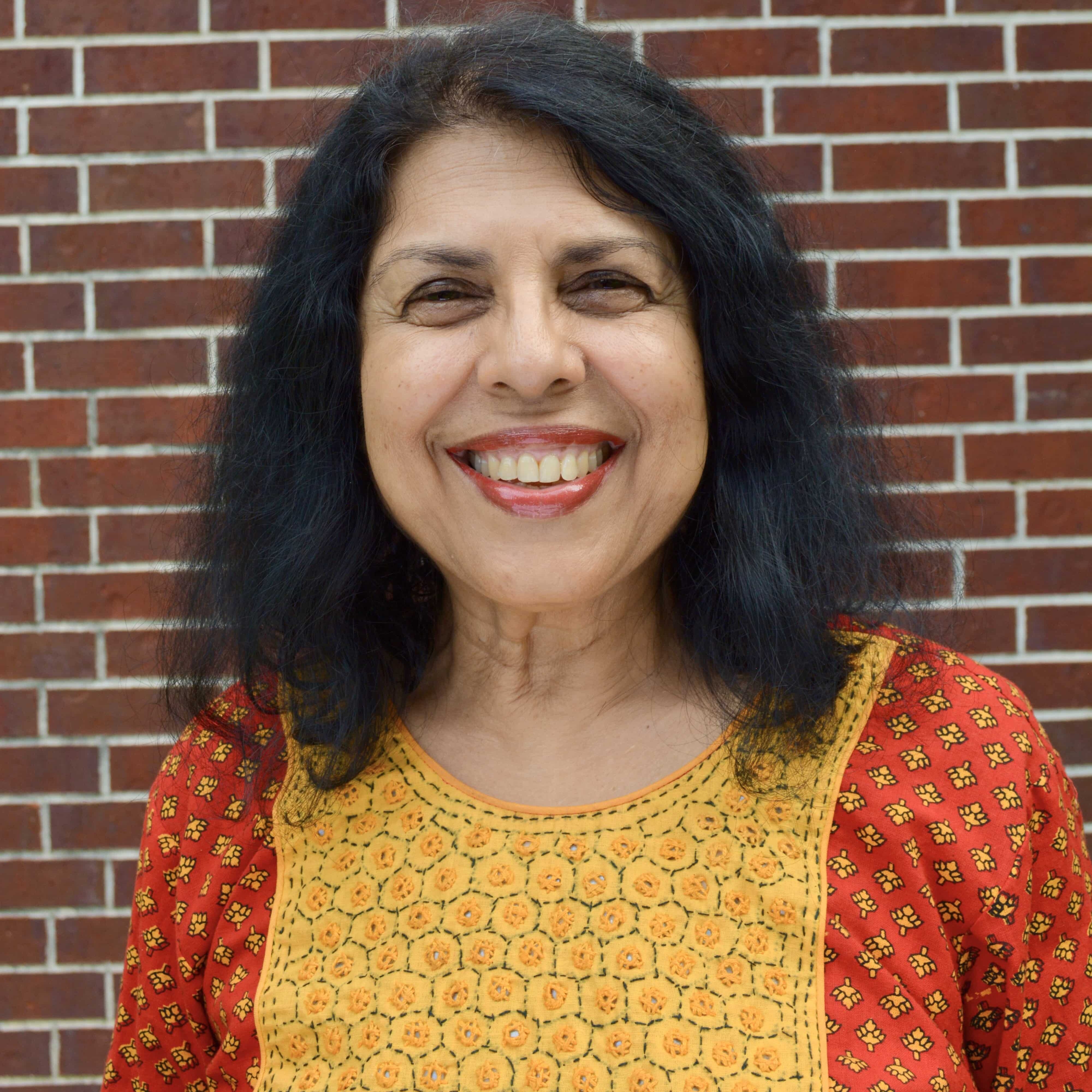
Chitra Banerjee Divakaruni
Award-winning author, poet, activist and teacher
Uplifting Women’s Voices Through Story and Service
By Mira Bhayroo
Chitra Banerjee Divakaruni’s books span centuries and geographies: from contemporary India and the Indian immigrant experience to Indian history, mythology, and epic. Growing up in a household that loved stories, she was shaped early on by the storytellers in her family, especially her mother and maternal grandfather, who shared with her the tales of Indian mythology and history. Because so many of those stories centered men, Divakaruni made it her mission as a writer to spotlight women characters and women narrators.
That commitment to women’s voices runs just as deeply through her activism as it does through her fiction. While pursuing her PhD at Berkeley, Divakaruni began working with the university’s Women’s Center alongside survivors of partner violence. That work led her to co-found Maitri in the San Francisco Bay Area, an organization that supports South Asian families facing domestic violence, emotional abuse, cultural alienation, and family conflict. She and her co-founders recognized a critical gap: while mainstream organizations offered legal, medical, financial, and counseling support to survivors, few if any could serve South Asian immigrant women across the cultural and language barriers they faced. Since moving to Houston, she has continued this work on the Advisory Board of Daya, a sister organization serving the same need locally. She also serves on the National Advisory Board of Akshaya Patra and has long supported Pratham’s education work. For Divakaruni, storytelling and activism are inseparable: women’s empowerment is not only a recurring theme in her books, but also a cause she has spent decades advancing in practice.
Her path to this point was not an easy one. Divakaruni came to the United States at 19 to attend college and had to support herself through school all on her own. She worked a string of low-paying jobs and continued working night jobs even after classes began, including as editor of her college magazine. Some nights, too exhausted and too late to safely walk home, she simply slept on the office couch. It was a formative lesson in perseverance that she credits with teaching her how to work hard, push herself, and trust that she could get the job done- a lesson she says she first learned by watching her mother, a teacher who could not afford to give her gifts but gave her an excellent education instead, and who taught her that a woman needed to stand on her own feet and secure her own economic independence.
That same discipline shows up today in a part of her craft that readers rarely see: the extensive editing, rewriting, and polishing behind every book. Her cultural heritage and background, she says, are central to both her authenticity and her authority as a writer: they allow her to go deeper into her subjects than someone without that lived knowledge could, and to critique her own culture as an insider when the story calls for it.
Looking ahead, Divakaruni is candid about the changes reshaping her field. She sees artificial intelligence already influencing commercial fiction, even as she remains convinced that literary work will always require the human brain, human empathy, and the human artistic touch. As a custodian of both ancient Indian epics and contemporary diaspora voices, she continues to use that pull to connect the diaspora to its heritage and to introduce new audiences to stories that challenge male-dominated narratives and center women instead.
That work continues. Divakaruni is working on a new project:
“I am writing a different kind of novel, a fantasy adventure based on the folk literature of Bengal, where I come from, set in a dystopian world. I am quite excited about this and hope that it will reach readers of many backgrounds and age groups. It has—as you might expect—two heroines. Double trouble!”
Her books amplify the stories of women too often left out of the narrative; her advocacy has built lasting infrastructure for women who needed it most. Through decades of storytelling and service, Chitra Divakaruni has built a body of work that reflects the values Indiaspora seeks to celebrate: a diaspora that carries its heritage forward while using its voice and resources to lift others up.