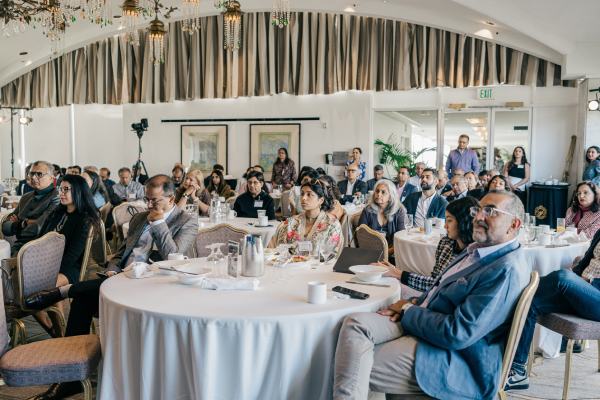

My husband and I have both spent time living outside India. When we left for university in the UK, we were young, independent and simply getting on with our new lives. But somehow, India kept finding its way into our lives.
I lived with six Indian girls — three from Delhi and three from Hong Kong — and somehow, the shared familiarity of India made us feel at home with each other. We cooked huge batches of rajma and other curries on weekends, packed them into the freezer and reached for them whenever we craved a taste of home. When our mothers visited, they arrived with stacks of parathas and cooked enough food to last long after they had left — though somehow, it never seemed to last long enough.
We celebrated Diwali at university, wore Indian clothes to formal events, spoke Hindi when we didn’t want our non-Indian friends to understand us, searched for Indian restaurants and grocery stores, and spent movie nights watching Bollywood films.
At the time, none of this seemed significant. It was simply life.
Both of us, through our individual experiences in the UK, noticed this even in Indian friends who were born and brought up there. They knew the rituals, spoke the language, sought out Indian food and carried an effortless familiarity with a place they didn’t necessarily live in. India travelled with us in ways we didn’t always notice.
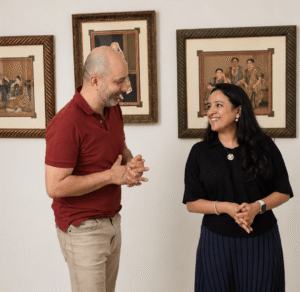
Years later, after living and working there and building our lives beyond university, we both moved back to India. I started my therapy practice, while Khurram began running his hotel in Srinagar.
Then COVID changed the way we connected with people.
My practice moved online almost overnight. The boundaries began to blur. Suddenly, I had clients not just from Delhi, but from different parts of India and even from abroad.
With the hotel much quieter, Khurram found himself spending more time at home, building new systems for work and adapting to a world that was suddenly connecting differently. He noticed friends and family creating mini online ecosystems for their children at home, bringing together the best people they could find, from different parts of the world.
But even as things opened up, something unexpected happened. People who could have chosen someone closer often chose to stay online. There was no driving, no parking, and no travel time built into the day. What had started as a necessity had become a choice.
This was particularly evident with some of my NRI clients. They had access to highly qualified therapists where they lived, yet chose to continue working with me in India.
I asked one client what made her choose to continue with me despite the time difference. Her answer stayed with me:
“Because you’re Indian. You get me.”
She didn’t have to explain the things that can make relationships complicated for many of us — why we often take time to work through important relationships, or why setting boundaries can be a process in itself. There was a shared cultural understanding that made the conversation more meaningful.
Other questions came from clients too: “Do you know an Indian nutritionist?” “Do you know a priest?”
These conversations made us realise how we were no longer choosing people simply based on proximity; we were choosing based on preference — who felt right, who understood our context, or whose expertise we trusted.
And that made us think about the many remarkable people in India whose work was often known only within their own circles — something Khurram had encountered repeatedly through his work.
As we talked about the experts that clients were looking to be connected with and the remarkable individuals Khurram had come across, a bigger question began to take shape in our minds: what if finding the right person didn’t have to be so difficult?
That question became Khidhki.
Today, Khidhki is a place to discover people and expertise in India — from wellness and spirituality to culture, language, the arts and beyond. A place where expertise meets something harder to put on a profile: familiarity, understanding and a sense of connection.
And perhaps that’s what makes India feel a little closer — not because we were ever far from it, but because there is always more to discover.
Website: khidhki.com
Instagram: @_khidhki_