Reclaiming Our Hearts: Lessons For South Asians at Risk for Diabetes and Heart Disease
April 1, 2026
Written by Dr. Sonia Anand and Dr. Sujane Kandasamy
Why We Wrote Reclaiming Our Hearts: Lessons for South Asians at Risk for Diabetes and Heart Disease
We wrote Reclaiming Our Hearts because we have spent our careers witnessing a troubling and persistent pattern: South Asians experience heart disease and type 2 diabetes earlier and more aggressively than many other populations. Too often, we meet patients in their 40s—or even 30s—already facing heart attacks, advanced diabetes, or multiple metabolic complications. We knew the science existed to explain why this happens. What was missing was a clear, culturally grounded resource that translated decades of research into practical guidance for our community.
As clinicians and researchers, we have collectively studied cardiometabolic disease for over two decades. Our work has explored genetic predisposition, early-life influences, migration, visceral fat biology, metabolic syndrome, and prevention strategies tailored to South Asians. But academic articles do not always reach families at the dinner table, community leaders, or young adults trying to understand their own risk. We wrote this book to bridge that gap.
South Asians—those with ancestry from the Indian subcontinent—carry a disproportionate burden of premature cardiovascular disease. This risk is not random. It reflects a complex interplay of genetic susceptibility, early developmental influences, and rapid lifestyle transitions associated with urbanization and migration. When South Asians move from rural or traditional settings to Western or highly urbanized environments, metabolic risk accelerates—often within a single generation.
Historically, even ancient South Asian medical traditions recognized conditions resembling diabetes. Classical Ayurvedic texts described “Madhumeha,” or sweet urine disease, and linked illness to dietary excess and inactivity. Long before modern epidemiology, there was recognition that lifestyle shapes metabolic health. Today, we understand this through the lens of insulin resistance and metabolic syndrome—but the roots of this knowledge are longstanding.
Over decades of global migration—to East Africa, the Caribbean, Southeast Asia, Europe, and North America—South Asian communities experienced dramatic dietary and activity shifts. Epidemiological studies consistently showed higher rates of premature heart attack, higher prevalence of diabetes, and clustering of early heart disease within families. These findings told us something important: inherited predisposition interacts strongly with environmental change.
Modern research now provides greater clarity. South Asians tend to develop diabetes at lower body weights. We accumulate more visceral fat—fat stored deep in the abdomen around the organs—even when body mass index appears “normal.” We also accumulate more liver fat. This pattern drives insulin resistance, abnormal cholesterol levels, inflammation, and ultimately heart disease.
One concept we describe in the book is the “thin-fat phenotype.” Many South Asians appear lean but have disproportionately high body fat percentage, especially centrally. This metabolic profile increases risk even in individuals who would not traditionally be labeled overweight. Standard screening tools developed for other populations often miss this nuance. That gap can delay prevention.
Genetics also play a role. For example, lipoprotein(a)—a largely inherited cholesterol particle—is elevated in many South Asians and contributes to early atherosclerosis and, in some cases, sudden cardiac events. But genes alone do not determine destiny. Risk emerges from the combination of inherited biology, early-life nutrition, and modern environments high in refined carbohydrates and sedentary patterns.
We wrote this book because we believe prevention must begin earlier—and must be culturally tailored.
We emphasize waist circumference as a powerful and simple screening tool. For South Asian women, a healthy waist circumference is under 80 cm; for men, under 90 cm. Abdominal obesity strongly predicts abnormal blood sugar, cholesterol, and blood pressure. We discuss the importance of identifying metabolic syndrome early, because its presence doubles the risk of heart attack.
Dietary guidance in the book is practical and culturally informed. We discuss embracing a low carbohydrate diet achieved by reducing ultra-processed foods and refined carbohydrates—including polished white rice, refined flour products, breads, and sweets—while returning to dietary patterns rich in lentils, beans, vegetables, whole grains, nuts, fish, and healthy oils. We outline the SAHARA dietary principles to help families make sustainable shifts without abandoning cultural identity.
Physical activity is another pillar. We encourage daily walking, aiming for approximately 10,000 steps per day, along with family-centered movement—dance, cricket, outdoor play—so that prevention becomes communal rather than individual. For those with elevated risk factors, we emphasize adherence to prescribed therapies such as statins and other cholesterol-lowering medications, which significantly reduce heart attack and stroke risk.
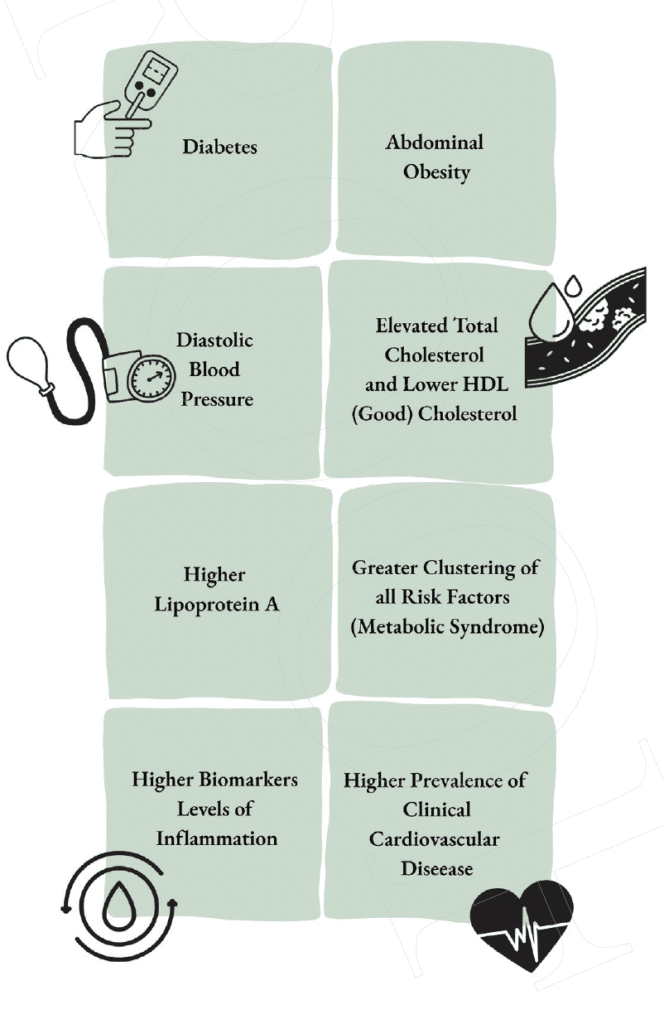
Risk Factors for Chronic Disease in South Asians:
Importantly, we also wrote this book to challenge stigma. Diabetes and heart disease are often viewed as inevitable within South Asian families. We reject that narrative. Risk is higher—but it is modifiable. Early detection, lifestyle adaptation, and evidence-based treatment can dramatically alter outcomes.
At its core, Reclaiming Our Hearts is about empowerment. It is about understanding that our community’s elevated risk is rooted in biology, history, and environment—but that knowledge allows us to intervene. It is about translating epidemiology and mechanistic science into kitchen-table conversations. It is about protecting the next generation.
We believe that culturally grounded prevention—starting in childhood, sustained through adulthood, and informed by both tradition and modern science—can meaningfully reduce the burden of diabetes and cardiovascular disease among South Asians.
We wrote this book because we want fewer premature heart attacks. Fewer missed diagnoses. Fewer families blindsided by disease that could have been prevented.
Most of all, we wrote it because reclaiming our hearts is not just a medical goal—it is a collective responsibility.
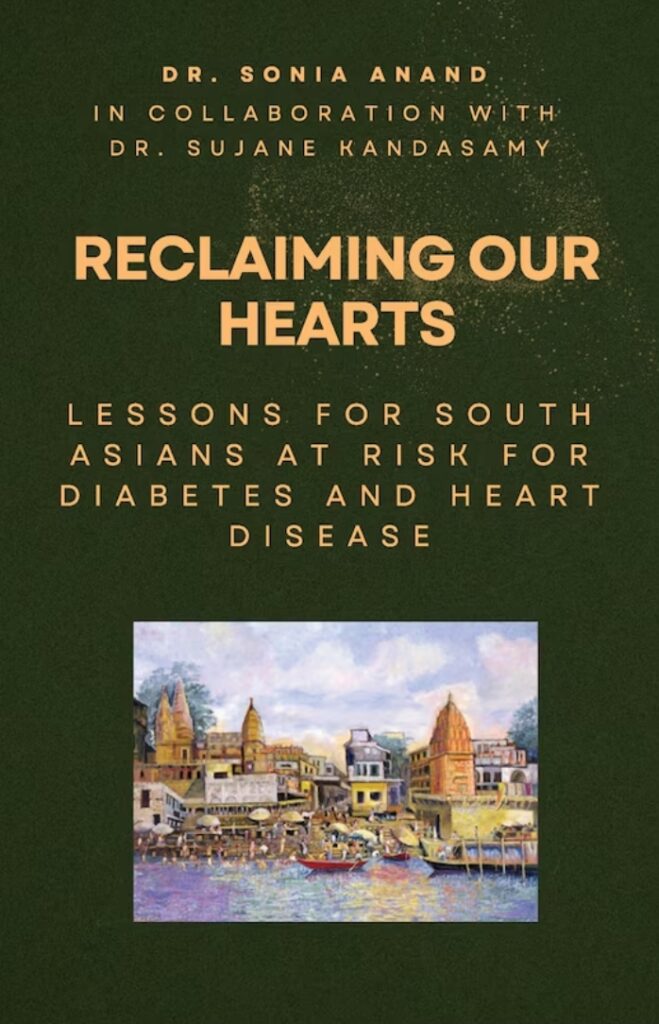
To read in more detail about the above, including additional references and articles, please review, “Reclaiming our Hearts: Lessons for South Asians at Risk for Diabetes and Heart Disease.” The book, written by Dr. Anand and Kandasamy is available on Amazon and Indigo.

Dr. Sujane Kandasamy is an Assistant Professor in the Mary Heersink School of Global Health and Social Medicine, Department of Medicine, McMaster University. She is a mixed-methods health researcher, implementation scientist, and knowledge mobilization expert.
Dr. Sonia Anand is a Vascular Medicine Specialist and Professor of Medicine & Epidemiology in the Department of Medicine at McMaster University. She is the Associate Vice-President of the Mary Heersink School of Global Health and Social Medicine at McMaster University and holds the Heart and Stroke Foundation of Ontario/Michael G. DeGroote Chair in Population Health Research.