Building Opportunity Where People Live
August 26, 2026
In Vadapuri, Maharashtra, Ashwini and Supriya Tai worked long, grueling days, dividing time between their family farm and laboring on neighboring fields. Their work sustained the household but gave them little economic independence. Social barriers and gender norms also kept them encumbered, denying them autonomy and a means to use their education.
Sarojini Phadtare, a rural entrepreneur with an eye to social impact, enabled them to escape this stifling situation. Looking beyond their poverty, she saw entrepreneurs in the making. Sarojini encouraged them to process their groundnuts rather than sell them as raw crops, providing financial support and a buyback arrangement using which they established a cold-pressed oil enterprise.
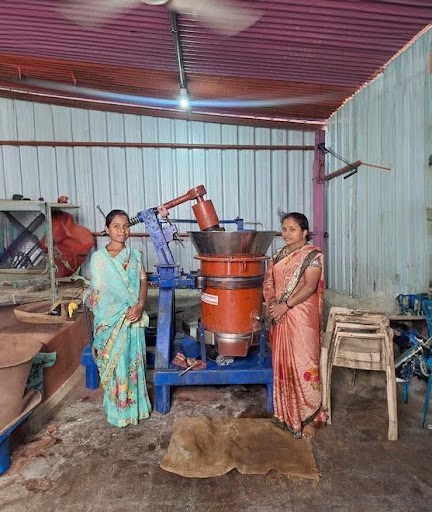
Groundnuts that earlier fetched around INR 95 per kilogram were then converted into oil selling for about INR 280 per litre. This shift nearly doubled their earnings from the groundnut, allowing them to educate their children and meet their family’s needs. Beyond the revenue increase, Ashwini and Supriya’s confidence soared. Standing beside their oil machine, they were no longer simply supporting a family livelihood. They were running an enterprise, making decisions, managing production and earning from their own business, giving them something more powerful than income: agency over their economic lives.
Their story struck a powerful chord with me, providing an answer to a dilemma from the 1990s, when my encounters with rural India underscored that restrictive socio-economic circumstances were part of life for millions of rural Indians. Limited economic opportunity deepened poverty. Poverty pushed people to migrate. And when people left to find work, villages lost their workforce along with their ambition, skills, and potential.
I wondered what it would take for communities that had so little to begin with to gain control over their economic futures. What if villages could become places where businesses grow, jobs are created, women gain economic agency, farmers capture value, and young people can imagine a future?
Entrepreneurship, I found, unlocks this transformation. This is the possibility which The Buddha Institute activates by nurturing entrepreneurship to foster social change.
When opportunity reaches the village
In the tribal village of Suthar Madra in Rajasthan, Kosa Devi’s family once depended on daily wages and small-scale farming, earning around INR 4,000 a month and only finding work during a few months. This made it difficult for her to make ends meet and prevented her from improving her family’s conditions.
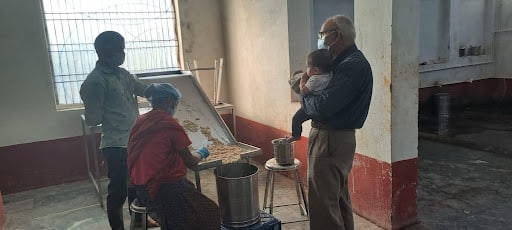
Her circumstances changed when Rakesh Gupta, a Buddha Fellow, helped her to see new possibilities. Rakesh started gathering women in the village to collect, sort and access better markets instead of only selling produce individually to local traders.
He also supported Kosa to install a water-lifting system, enabling her to grow vegetables beyond the seasonal harvest. She began supplying vegetables to Udaipur and started a small plant nursery, allowing her to increase her income, send her children to a private school and become confident in managing her earnings.
Kosa’s story illustrates what happens when rural people are supported not simply to find work, but to identify and build businesses around opportunities present in their communities. This is something which entrepreneurs like Rakesh do by helping people to build resilient livelihoods.
One mill. One woman. A future rebuilt.
In Raisen, Madhya Pradesh, Sangita Devi’s family once depended on seasonal farming and her husband’s daily wages as a mason. Seeing the potential to build a more reliable livelihood around agricultural demand, Buddha Fellow Jaspal Singh helped Sangita to invest INR 3 lakh in a flour mill, grading machine and packaging unit. He connected her with buyers beyond her village, opening up new markets and encouraging her to think beyond subsistence production. Today, farmers travel up to eight kilometres to use her mill, where custom milling, wheat grading and flour sales generate INR 6,000–7,000 a month. With Jaspal’s continued support, Sangita is exploring premium markets and ways to scale her enterprise. Her ambition is already extending beyond her own livelihood, with her emphasising that “When regular orders start coming, I will employ more women from my village.”

That is the transformation that the Buddha Institute generates: an entrepreneur who becomes an employer, a business that becomes a local opportunity, and an opportunity that multiplies manifold.
Building the Buddha Institute
My encounters with rural India made it clear that lasting development requires treating people as owners and creators of their economic futures rather than passive beneficiaries. That insight led me to start the Buddha Institute in 2018.
Across India’s villages and small towns, entrepreneurs like Sarojini, Rakesh and Jaspal are bringing about change through entrepreneurship, opening opportunities for women and young people. They are Development Entrepreneurs who use their enterprises as vehicles for wider socio-economic change.
Through the 24-month Buddha Fellowship, Development Entrepreneurs receive financial support, mentorship, business development, learning opportunities, and ecosystem connections. The approach begins with what entrepreneurs already possess—local knowledge, resilience, relationships and ambition—helping them turn these into stronger enterprises that generate opportunities. The Fellows, therefore, are not the end beneficiaries. They are the instruments through which opportunity travels deeper into communities.
Since 2018, the Buddha Institute has supported 70+ Development Entrepreneurs, creating over 3,000 jobs and impacting more than 500,000 lives. The ambition now is to nurture 1,000 Development Entrepreneurs by 2030, capable of creating 100,000 jobs and improving the lives of 25 million people. This is not a distant vision. It is already visible in entrepreneurs like Ashwini, Supriya, Kosa and Sangita.
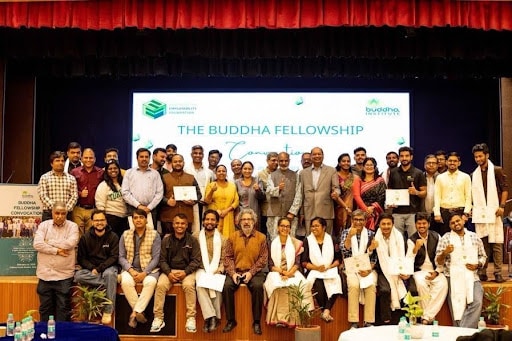
For donors and partners, this is an opportunity to invest in local enterprises that trigger powerful ripple effects—where food processors hire local women, farmers secure fairer prices, and young people find work without migrating. It is an investment in a model of rural development rooted in enterprise, dignity, and local leadership.
Because the most powerful way to change a community may not be to give it a solution. It may be to help someone from that community to build one.
Get in touch with The Buddha Institute to learn more about its work.
Website: https://thebuddhainstitute.org/
Ved Mitra Arya, Founder: vedarya@thebuddhainstitute.org