

By Raj Gupta and Dana Chan
The India Philanthropy Alliance (IPA) is a network of dozens of organizations working together to enhance collaboration and to increase the amount and quality of American philanthropy to India. We are grateful to Indiaspora for funding IPA in its first year and incubating it for our first half-decade.
In 2025, Dalberg, in partnership with IPA and Indiaspora, released a report that found that diaspora giving to India had significantly increased from their earlier report in 2018. The report further found that imbuing philanthropic interest and activity among American youth towards India was a big opportunity for the future.
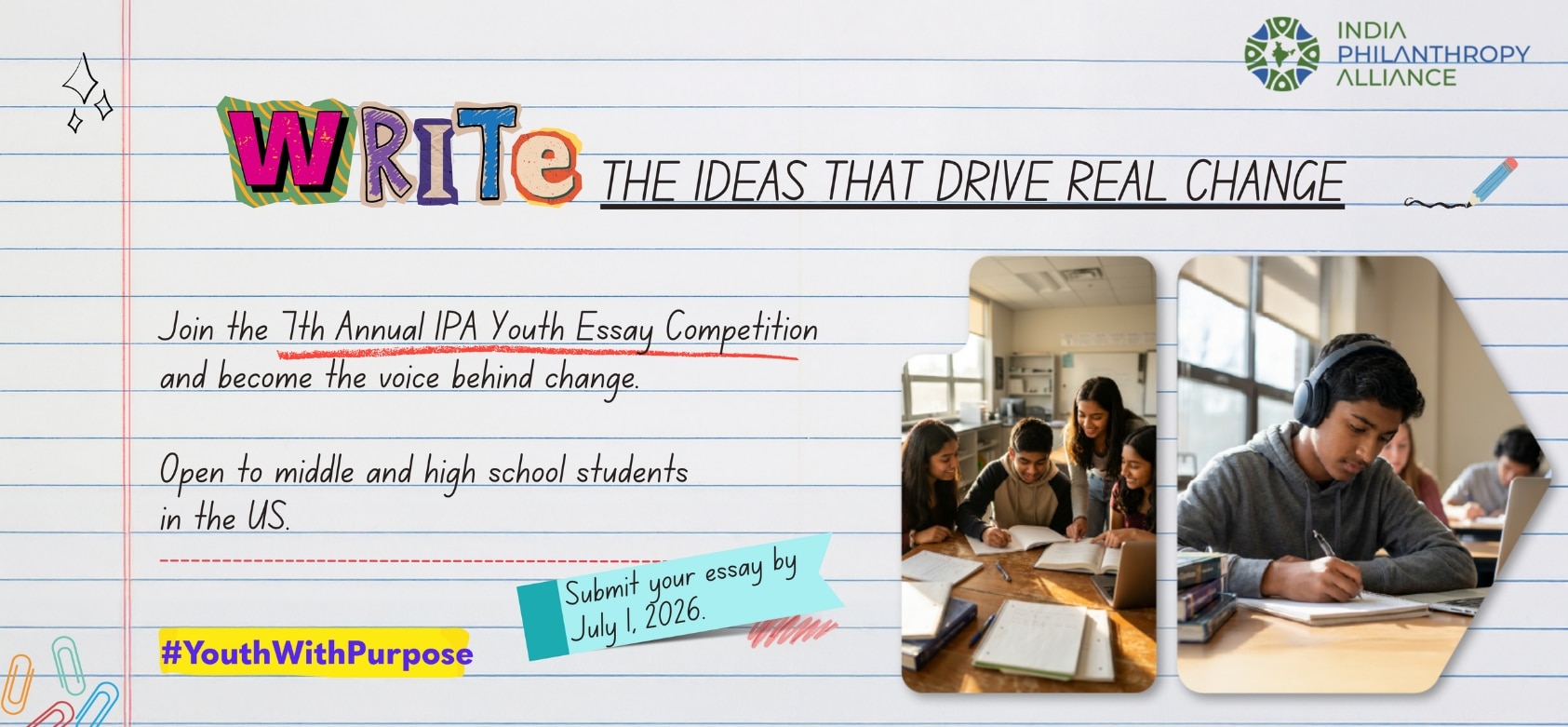
It turns out that IPA has been working on addressing this issue for a long time. As a way to introduce diaspora youth to the possibilities and joys of philanthropy to India, IPA established the Youth Essay Competition in the spring of 2020. Now in its 7th year, this year’s theme is #YouthWithPurpose.
IPA invites students to identify an area of need in India and write a well-researched personal essay where they propose solutions to the problem. The competition is open to U.S. residents in middle school and high school. The essays are evaluated anonymously by a panel of independent and respected judges consisting of philanthropists, nonprofit professionals, and even a few past participants in the competition.
This is a great opportunity for the students to enhance their critical thinking and writing skills. It is also a chance to get them thinking about how philanthropy can enrich their lives for decades to come.
Indeed, new research summarized in Sharmila Rao Thakkar’s article Giving is Good for You cites growing evidence that giving of one’s time and money, especially when practiced intentionally and consistently, measurably strengthens the emotional, social, physical, and even professional well-being of the giver. Considering this, why should youth put off philanthropy until their later years? We see no reason for such delays.
The essay competition thus helps spur dinner-table conversations between the generations about all the benefits of generosity. It is one of many IPA initiatives to engage and recognize emerging leaders. Another example is the Deepak Raj Rising Star Award that will be given each year starting in 2026 to someone under 40 to honor their philanthropic generosity and civic leadership. (Nominations for the inaugural award are due June 30.)
Profound Insights from Youth
Philanthropy is deeply personal to most people. Channeling this insight, IPA encourages participants to write about a societal problem that can be addressed through philanthropy to which they have a personal connection. In 2025, Aneesh Gupta won the High School category with his unique and heartfelt essay titled, India’s Invisible Children and the Fight for Recognition. He sees himself as a student deeply interested in healthcare equity and data justice, which examines how data collection can impact marginalized communities. He wrote about the lifelong struggles that unregistered babies have throughout their lives. As he puts it starkly, “One of the reasons I wrote my essay was as a call to action to make sure that every child is counted, because every child counts.”
One of the most important aspects of our competition is that we allow winners to direct $1,000 to the charity of their choosing (as long as it is a reputable organization working in India that has all the permissions required to receive money from the United States). Students are thrilled by this opportunity to practice philanthropy prior to entering the workforce. In Aneesh’s case, he had a goal to work with a nonprofit and directed his grant to CRY America, which assists poor children who are impacted by being unregistered. After receiving this honor, he met with CRY America’s Executive Director, who expressed appreciation for the essay and how it brought awareness to a critical issue.
Another shining example of our competition at work is Esha Kondapalli, the 2025 Middle School winner. Her essay about India’s Rabies Epidemic and how to combat it won the top prize in her age category. After being notified, Esha said, “I entered IPA’s Youth Essay Competition because of my deep passion for writing. Writing has always been my way of expression, especially on issues I care about.” The recognition that the award brought to her made her more aware than ever of her power as a changemaker.
Very recently, Eisha Yadav, who won the Middle School essay competition in 2021, wrote to us to share the news that she is going to UC Berkeley to study computer science. She mentioned that winning that competition gave her new confidence and insights, and that it helped propel her into getting accepted at such a prestigious university.
Creating networking opportunities
Essay competition finalists are given the opportunity to present their essays to the panel of judges, which will give them the opportunity to practice their public speaking skills, in addition to their writing skills. (It is also one of several ways that we screen out AI-generated essays.) The authors of the top essays from both the Middle School and High School categories will be invited to speak in a fireside chat about their essays at the Indiaspora and IPA Philanthropy Summit in Dallas, Texas, in September.
This speaking opportunity helps push back on the ageism that tends to pervade philanthropy, where young people are expected to be seen but not heard. The panel of essay competition winners is consistently ranked as among the top panels at philanthropy summits dating back to 2020.
As mentioned above, the top two essays in both middle school and high school will also each be awarded grant money to dedicate to the nonprofit of their choosing. Additionally, for the first time, the top 10 finalists in the High School category will be invited to participate in the World Food Prize Global Youth Institute in Des Moines, Iowa, this October.
Each of these growth and impact opportunities represents a chance for the next generation to learn more about philanthropy, networking, and education. Past essay winners have gone on to become members of the IPA Youth Leadership Council, run their own fundraising campaigns for India Giving Day, served as interns for IPA, and had their essays featured on the IPA website and social media pages.
How to participate
We encourage all Indiaspora members and friends to share this opportunity with high school and middle school students, and those who influence them. Talk to your children, grandchildren, nieces, and nephews, or simply send them an email or WhatsApp message about this opportunity.
Students must submit their essay by July 1 to have their voices heard, enhance their writing skills, increase their networking opportunities, and have a chance to donate their grant award to an organization of their choosing. Please contact IPA Program Officer Dana Chan at dana@indiaphilanthropyalliance.org with any questions, suggestions, or offers to help us make this the best year ever for IPA’s Youth Essay Competition.