India Giving Day and the Growth of Indian American Philanthropy
March 4, 2026
By Alex Counts, Minoo Gupta, Nishant Pandey, Deepak Raj, and Nalini Saligram
“Let me suggest that Indiaspora lead an effort to triple Indian American philanthropy over the next five years.” With those prophetic words, Sunil Wadhwani challenged the five of us, and the other attendees at the 2018 Indiaspora Philanthropy Summit, to dig deep and work hard over the next half decade. We are pleased to report that the community responded to this bold challenge with concerted action that led to success.
Sunil spoke those words in the immediate aftermath of Swetha Totapally of Dalberg presenting a report on Indian American philanthropy earlier in the day. She shared two seemingly contradictory findings. On the one hand, according to a survey of more than 1,000 Indian-Americans, the community volunteered its time with nonprofits at almost double the rate nationally for all Americans. On the other hand, it also found that Indian Americans contributed money to charities at roughly one-third the rate that Americans do on average, after adjusting for their incomes and wealth. Rather than focusing on celebrating the positive findings or questioning the reliability of the more challenging ones, Sunil simply called on the attendees to do better at doing good with their wealth.
The Community Responds
In response to this challenge, the India Philanthropy Alliance, which was then in its infancy, began studying reports about Indian diaspora giving that had been published by the John D. and Catherine T. MacArthur Foundation, Bridgespan and Dasra, the Gates Foundation, Give, and others. Each had concrete recommendations for how to increase donations. We also facilitated community-wide brainstorming sessions, such as one held at the 2018 Indiaspora Forum that generated 16 actionable ideas. Furthermore, IPA promoted research showing that those who give more time and money to nonprofits tend to be happier, healthier, and wealthier than those who give less, or not at all.
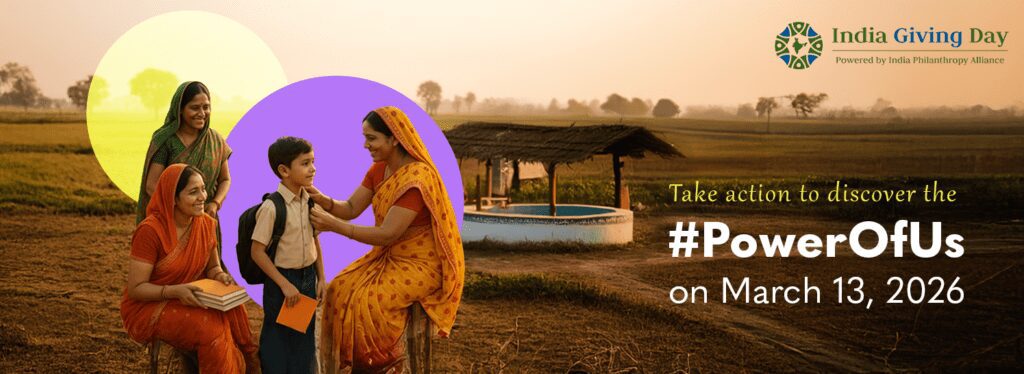
We were particularly struck by the recommendations in the 2016 MacArthur Foundation report to “promote national campaigns for giving” and to “organize Internet Talkathons.” These proposals led us to launch India Giving Day in 2023 and INDIA GIVING DAY LIVE! for the first time on March 13, 2026.
As challenging as it can be to come up with concrete recommendations for something as significant as increasing charitable contributions from $1 billion to $3 billion, it was even more daunting to choose among those options and then implement them over several years. But that is exactly what IPA did alongside allies such as Dasra/Giving Pi.
On the five-year anniversary of Sunil’s challenge, IPA joined hands with Indiaspora to commission Dalberg to do a follow-up survey that would serve as a report card to ensure accountability for our collective efforts. Hundreds of Indian Americans completed the survey during 2025, providing details about their giving in 2024.
A Breakthrough Achieved
While we were prepared for the study to show that donations as a percentage of income had grown only modestly or even decreased due to changes in tax laws, we were thrilled to learn that giving was estimated to have increased from $1 billion in 2018 to an astonishing $3-$4 billion in 2024, meeting if not exceeding Sunil’s ambitious goal. We celebrated the impact of our various campaigns to grow the philanthropy pie—rather than focus on fighting for bigger slices of a fixed amount—and how the increase in resources was helping improve education, health care, vocational training, eldercare, environmental protection, and animal rights in India.
It shouldn’t be surprising that a community as vibrant as Indian Americans would be able to set such an ambitious goal and then achieve it. This has occurred in other areas, such as in politics thanks to the diligent organizing of Indian American Impact.
The Agenda Ahead
However, we are far from complacent. Even as IPA seeks to accelerate the growth in the total amount of giving, including to domestic causes such as Hunger Mitao, we are setting our sights on related goals that are no less important.
First, we seek to improve the quality of giving. As an important first step in that direction, we have published guidelines for high-impact philanthropy and promoted them in a widely circulated article in the Stanford Social Innovation Review and also during the latest iteration of Indiaspora’s Philanthropy Summit which is now co-led by IPA.
Second, we want to better engage young professionals in effective philanthropy to India through a growing number of youth-engagement initiatives including our annual Youth Essay Competition (which will be launched for the seventh time on India Giving Day 2026).
Third, we believe that philanthropy should be, above all, a joyful activity rather than one prompted by guilt or a transactional mentality, and that it should meaningfully benefit the low-income people while helping bridge the economic gaps in vulnerable communities.
Supporting People and Platforms
People often want to ensure that their donations go directly to vulnerable people, communities, and ecosystems. This is doubtless a well-intended desire, and one that is often appropriate. But the rapid scaling of Indian American philanthropy also underscores the importance of investing in platforms for collective action such as Indiaspora, the India Philanthropy Alliance, Myriad USA, Dasra, and others. For example, had the Indiaspora Philanthropy Forum not been convened in 2018, it is easy to imagine that Indian American philanthropy would not be nearly as far along as it is today.
We would therefore like to thank each and every one of you who contributed to this community-wide achievement, especially the sponsors of India Giving Day including the Ford Foundation, the MacArthur Foundation, Aatmic Philanthropy, the Sehgal Foundation, Avestar Capital, Parichute and others.
We encourage you to give generously between now and March 13 to one or more of the 51 nonprofits participating in India Giving Day 2026. Remember that India is home to some of the world’s most efficient and effective nonprofits, and IPA’s India Giving Day Steering Committee has chosen several dozen of the very best among them for this year’s campaign. In the days ahead, we hope that you show them some love.
About the Authors
Alex Counts is the Executive Director of the India Philanthropy Alliance. Minoo Gupta is a Board Member of the Foundation for Excellence U.S. Nishant Pandey is the CEO of American India Foundation. Deepak Raj is the co-founder of the Neera and Deepak Raj Family Foundation and a past chairman of Pratham USA. Dr. Nalini Saligram is the Founder and Chairperson of Arogya World. All are or have been active board members of IPA.