Of Woman Born-Roobina Karode
May 2, 2026
Nalini Malani’s artistic practice has been one of the most compelling and inspiring part of my curatorial journey. In the formative years of KNMA, Nalini was one of the artists’ works that set a tone for me — of what art could demand of its audience, and of what a museum could stand for. We had the privilege of working on Nalini’s three-part retrospective in 2014, the first-ever in India, and of supporting her large-scale retrospective at the Centre Pompidou, among others. This newly commissioned project in Venice feels like a natural extension of that long journey together. For KNMA, bringing Nalini’s imagination to the global stage of the Venice Biennale this year titled “In Minor Keys” is both a curatorial conviction and something close to a shared responsibility.
What moves me most, when I reflect on Nalini’s practice across more than five decades, is the consistency with which she has held space for what I can only describe as a paradoxical experience of trauma. Her artistic consciousness is structured around the persistence of a foundational wound, the partition of Undivided India, and the violent displacement that followed. It is a wound that refuses to be buried in history, making its brutal presence felt again in the communal violence of 1992, 2002, and 2018. Nalini’s journey from paintings and drawings to Mylar cylinders and iPad animations is not a linear development but a discontinuous unfolding of artistic forms, where each form interrupts the apparent naturalness of the previous ones, insisting that meaning erupts through rupture rather than through seamless evolution. Drawing, too, evolved for her into an intimate way of ordering an inner reality: its fears, anxieties, and uncertainties that constitute the lived experience of those who do not hold power.
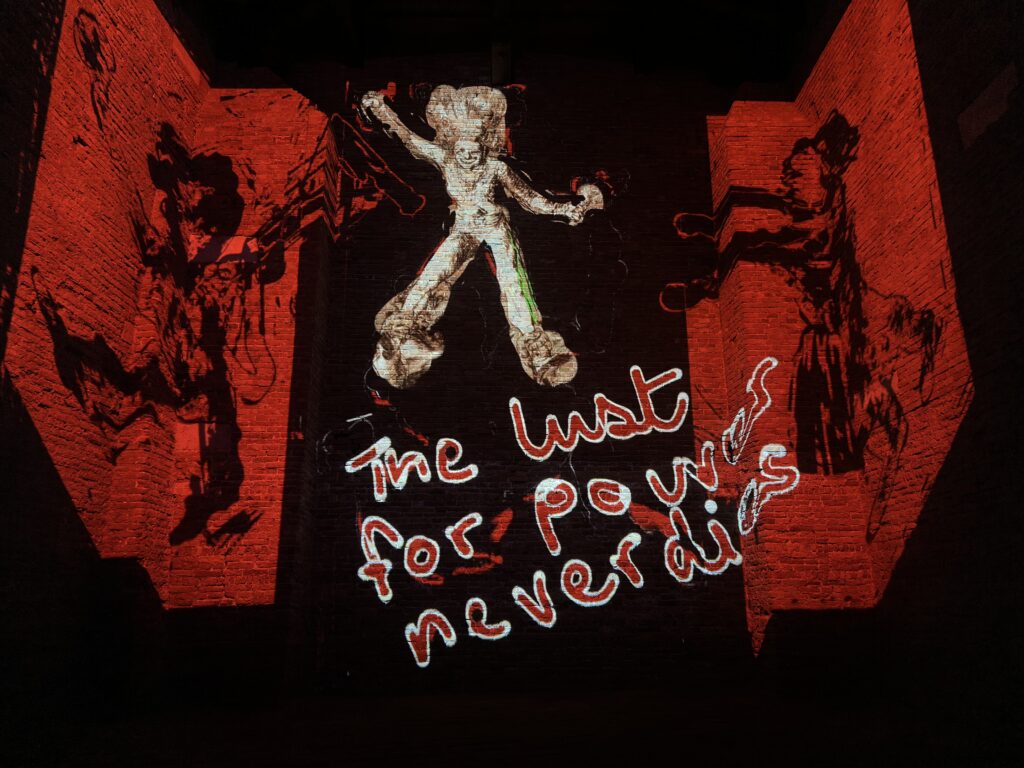
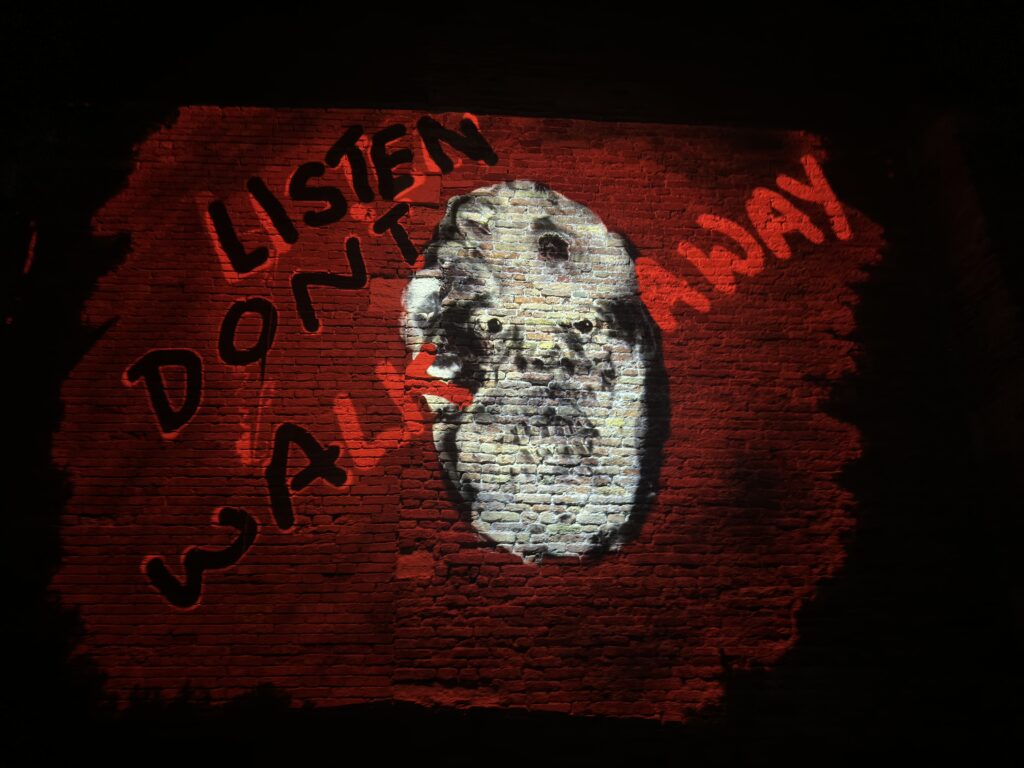
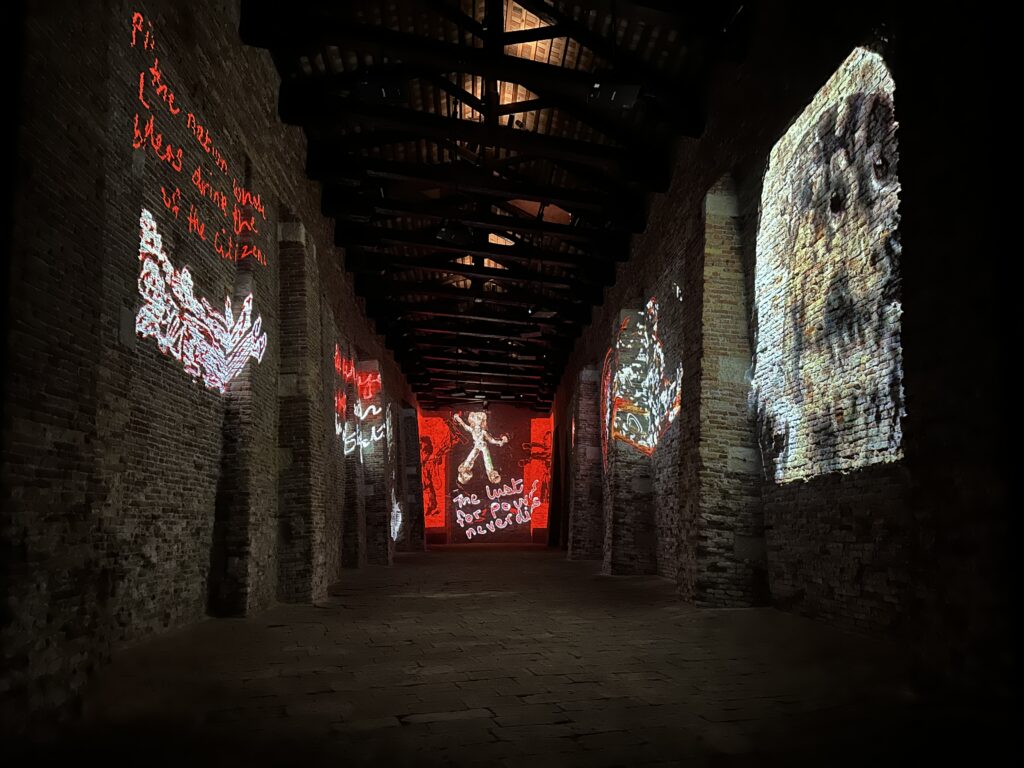
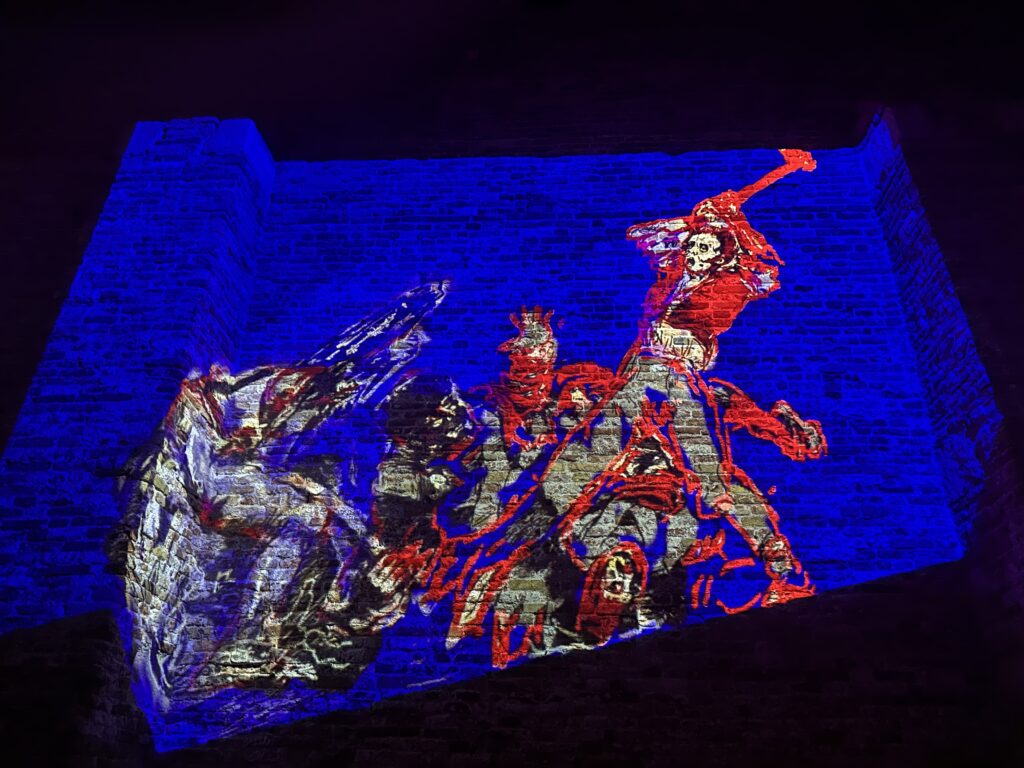
9 channel iPad Animation Chamber,
sound, dimensions variable
Collection – Kiran Nadar Museum of Art
© Nalini Malani
Nalini’s Of Woman Born in Venice invites us to leave behind fixed ideas of geopolitical imagination. It prompts us to ask: For whom is history written? What would our maps, our myths, our futures look like if they were redrawn from the perspective of the vanquished who survived the horrors of war?
Conceptualised as an animation chamber, it draws on the Greek myth of Orestes, who kills his mother to avenge his father and is absolved by Athena, a goddess not born of a woman. Through this divine pardon, the maternal body is severed away from law and justice even as it remains the origin of life. For Nalini, this is no archaic story. It still haunts our present, when wars and occupations are justified as self-defence, and devastating violence unfolds with no true reckoning. Nalini summons the Furies of our time, not only as goddesses of vengeance, but along with the unseen and unheard, the displaced and mourning. She foregrounds this absent agency of women who bear the deepest wounds of conflict yet remain central to the possibility of another world.
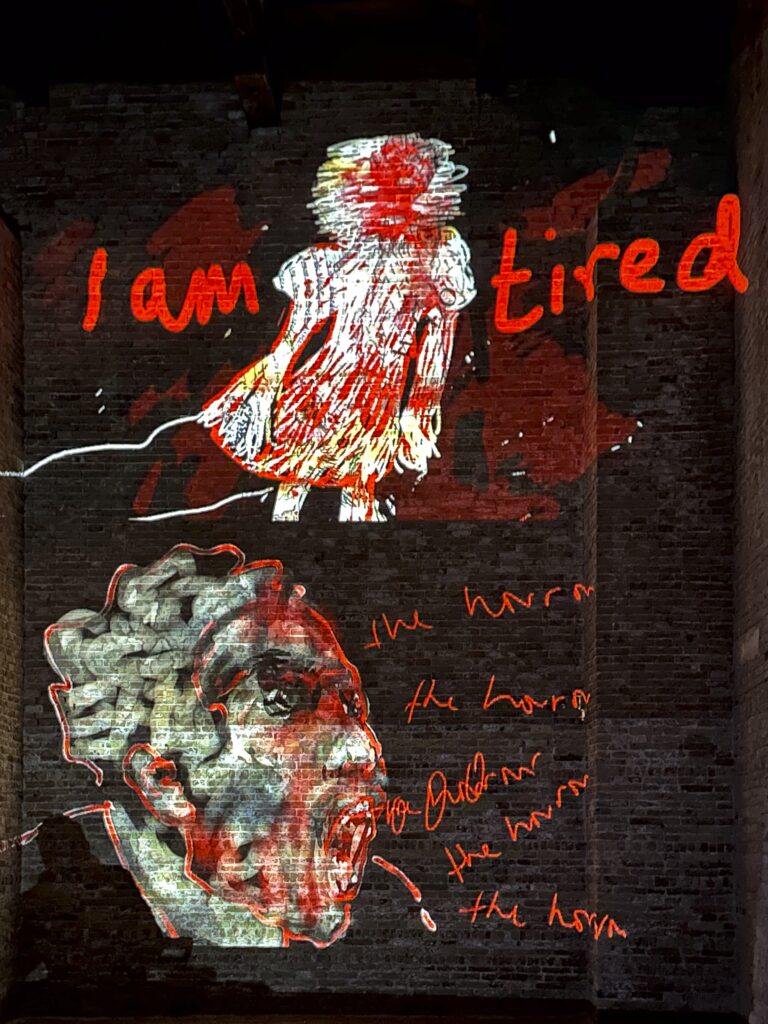
9 channel iPad Animation Chamber,
sound, dimensions variable
Collection – Kiran Nadar Museum of Art
© Nalini Malani
Across nine channels of projection, Of Woman Born leads us into a deep, dark cave-like chamber with moving images. Mythic figures, drawings, silhouettes, drifting texts and apparitions refuse to settle down into a single coherent narrative. A haunting soundscape of twenty minutes courses through the space, superimposing the past and present, myth and memory, justice and impunity. We are invited into this unsettling space/chamber not to resolve the story of Orestes, but to live through its afterlives, and to listen to the dispossessed women whose muted histories return here with a demand to be heard.
The layering in Nalini’s work is also a reminder to us that memory operates in a form of superimposition wherein the past and present, personal and collective memory, individual trauma and historical violence become indistinguishable. The viewer’s body gets drawn to the site of political contestation in the acceleration and disorientation played out by the visual and spatial experience of animation chambers. The exhibition space does not simply remain a meditative or contemplative space, but is transformed into a field of perceptual struggle, testing our ethical capacity to witness violence without mastery or resolution. This supersaturation of multiple projections, overlapping voices, and accelerating gestures latches onto the viewer’s body, making them co-witness to the acts of violence. In the animation chamber, looking afresh is not a choice, but a necessity of perpetual renewal demanded by the work’s refusal of closure.
On behalf of the Kiran Nadar Museum of Art, I welcome you to the experience of Nalini Malani – Of Woman Born, the official collateral of the Biennale Arte, Venice, 2026.
About the Artist
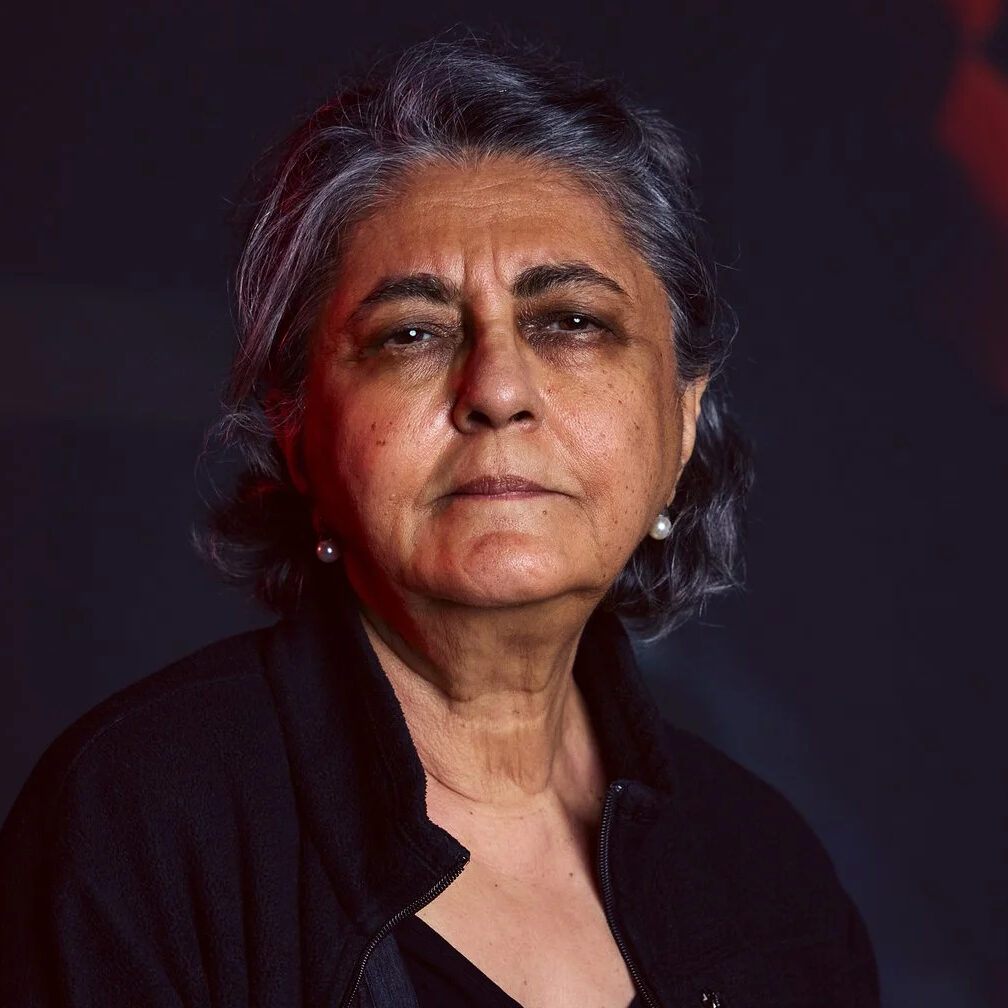
Nalini Malani (born in 1946 in Karachi, undivided India) is a pioneering Indian contemporary artist with an artistic practice that spans over six decades. Her work encompasses film, camera-less photography, reverse painting, wall drawing/erasure performance, theatre, animation, and video/shadow play.
Initially rooted in the disciplines of painting, filmmaking, and photography, Malani’s artistic practice took a radical turn in the late eighties. Confronted by the rising waves of orthodoxy, Malani extended beyond the possibilities of canvas, reaching a wider audience through the potent expression of theatre, ephemeral wall drawings, and the mesmerising allure of video/shadow plays. In these works, she draws deeply from historical events and her personal experience of the Partition of British India, giving voice to the marginalized through her evocative visual stories. Her art investigates the questions of gender, race, social inequality, and cultural identity.
The protagonists in Malani’s art emerge from across Indian and European mythologies. She draws references from the underbellies of history and culture, crafting epic narratives that simultaneously emerge and dissolve before our eyes. For Malani, it’s crucial to reflect on how humanity is absorbing the impending sense of crisis and catastrophe. She does this by unsettling our ingrained ways of seeing both art and life. Her socially engaged work continues to illuminate and inspire several generations of creators from the Global South.
Malani’s work has been exhibited in 29 solo Museum exhibitions, including four retrospectives, 22 biennales, and over 200 international museum group presentations. A major breakthrough came in 2012 presenting ‘In Search of Vanished Blood”, at dOCUMENTA(13), when the rotating reverse painted cylinders in a video/shadow play became her international signature. In 2014, the Kiran Nadar Museum of Art organised a year-long retrospective, “You Can’t Keep Acid in a Paper Bag,” curated by Roobina Karode. In 2017/18 the Centre Pompidou in collaboration with Castello di Rivoli organised the two-part retrospective “The Rebellion of the Dead”. And in 2021 M+ presented in their opening exhibition Malani’s solo “Vision in Motion”. Looking ahead, 2027 will witness the Tate Modern’s major survey exhibition ‘The Future is Female’ on Malani’s extensive oeuvre, which coincides with the 80th anniversary of the Partition of British India. Malani’s work is now held in the esteemed collection of 50 museums worldwide, including M+ in Hong Kong, KNMA in New Delhi, British Museum and Tate Modern in London, MoMA, MET, Guggenheim in New York, Centre Pompidou in Paris, the National Museum of Modern and Contemporary Art in Seoul, and the Art Gallery of South Australia in Adelaide.
Malani’s formative artistic journey began with a Diploma in Fine Arts from Sir J.J. School of Arts, Bombay, in 1969. Her pursuit of artistic research continued with the prestigious French Government Scholarship for Fine Arts, allowing her to study in Paris from 1970 to 1972. In 2021, she became the first recipient of the National
Gallery of London International Fellowship. Malani has earned prestigious awards including the Kyoto Prize (2023) in Arts and Philosophy, the CAA Distinguished Feminist Award (2023), the Joan Miró Prize (2019), the Asian Art Game Changers Award (2016), the St. Moritz Art Masters Lifetime Achievement Award (2014), the Fukuoka Prize in Arts & Culture (2013), and in 2010 she was conferred an Honorary Doctorate in Fine Arts from the San Francisco Art Institute.
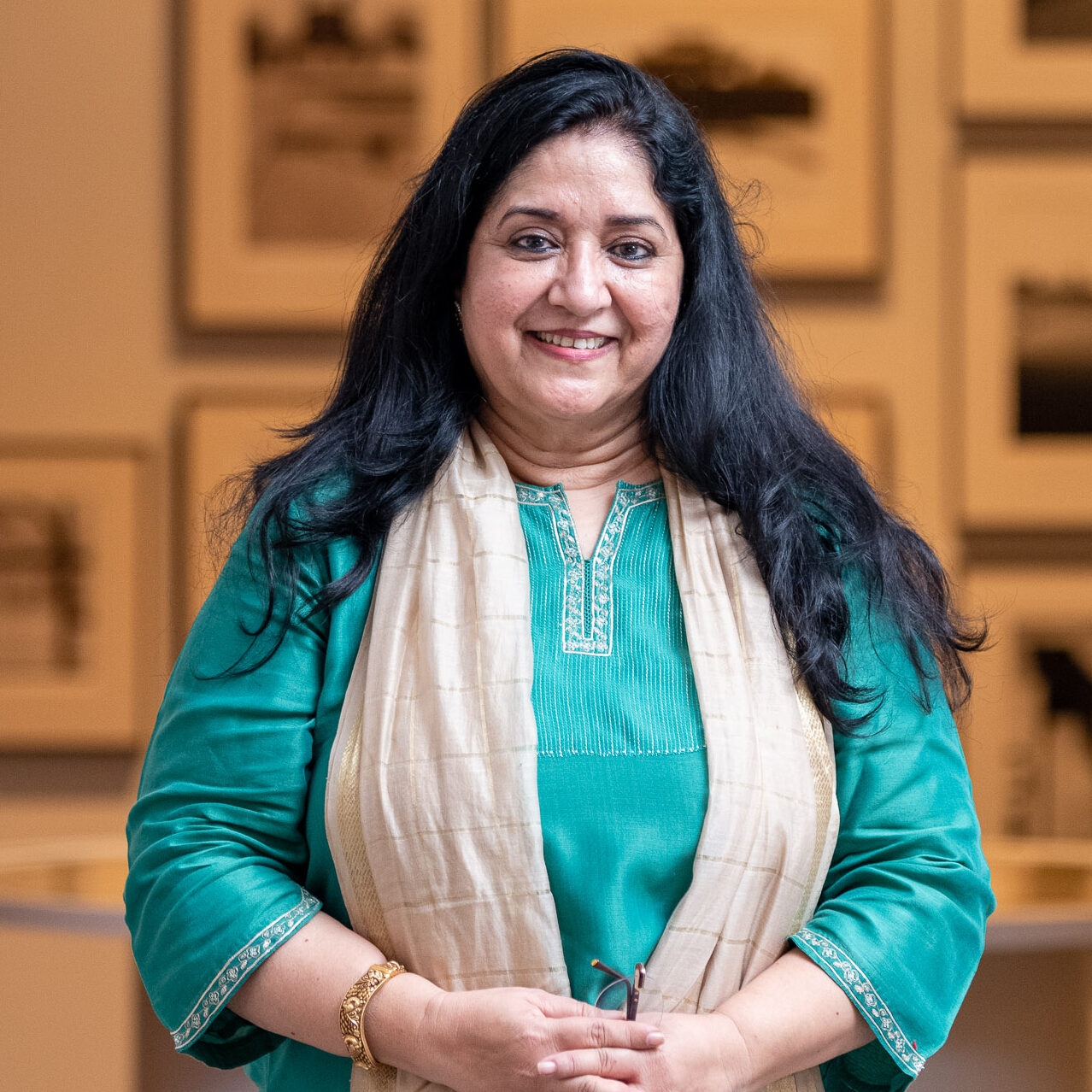
About the Curator
Curator, educator and art critic, Roobina Karode is the Artistic Director and Chief Curator at the Kiran Nadar Museum of Art (KNMA), New Delhi, India, since it opened its doors in 2010. She has post-graduate specializations in Art History and in Education.
Karode has over the years curated several significant exhibitions both within India and internationally, including seminal retrospectives on the art practice of Nasreen Mohamedi, at KNMA- Delhi, at the Reina Sofia Museum in Spain in 2015 and at the MET Breuer, New York in 2016. She curated a major monographic exhibition on under-represented intergenerational artists whose contribution has been crucial within the discourse of modern and contemporary Indian art such as Himmat Shah, Jeram Patel, Vivan Sundaram and Rameshwar Broota. Karode has been focused on women artists and their significant representation in the KNMA Collection. She curated Nalini Malaini’s retrospective “You Can’t Keep Acid in a Paperbag” in 2014 in 3 chapters, Arpita Singh’s “Submergence: In the midst of here and there” in 2019, and a solo exhibition of Jayashree Chakravarty titled “Earth as Haven: under the canopy of love” at the Musee Guimet in Paris in 2017.
In 2020, she curated a thematic exhibition focused on Abstraction and South Asian Women Artists titled “Scripting Time, Memory and Ecology” with a solo dedicated to Zarina’s practice. Atul Dodiya’s water colours painted during the pandemic titled “Walking with the Waves”, K. Ramanujam’s first-time comprehensive exhibition titled “Into the Moonlight Parade” and Somnath Hore’s centennial exhibition, “Birth of a White Rose,” were all curated in 2022, alluding to the human condition and the acute need for healing and empathy in the world. She recently co-curated POP SOUTH ASIA -artistic explorations in the popular, a largely unexamined theme with artist-professor Iftikhar Dadi, in collaboration with the Sharjah Art Foundation.
Karode has taught Art History, both Indian Modern and Western art from 1990 to 2006, at various institutions in Delhi, mainly the School of Arts & Aesthetics in JNU, the National Museum Institute, the College of Art and the Jamia Millia Islamia University. She was awarded the Fulbright Fellowship in 2000 and the Ford Teaching Fellowship in 2005-7. In 2019, Karode was the curator for the Indian Pavilion at the 58th Venice Biennale that earned its name in the first five must-see pavilions.
Steering a rigorous program at KNMA that aims to embrace and exhibit all art forms, Karode is focused on collaborations and partnering with other significant institutions to consolidate the global presence and relevance of contemporary Indian and South Asian art. Additionally, Karode has been a committee member of the Asia Society India for the past three years.
About the Kiran Nadar Museum of Art
Established through the initiative of avid art collector Kiran Nadar, the Kiran Nadar Museum of Art (KNMA) opened to the public in January 2010 as India’s first private museum dedicated to modern and contemporary art from the subcontinent. KNMA is a non-commercial, not-for-profit institution supported by the Shiv Nadar Foundation. It seeks to foster a dynamic relationship between art and culture through its exhibitions, publications, educational initiatives, and public programs. Committed to institutional collaborations and artist support networks, KNMA actively engages with diverse audiences through its wide-ranging programming. KNMA supports artists whose work engages with social and political questions while expanding global understanding of South Asian art. KNMA has presented major exhibitions by artists including Nalini Malani, Zarina, Nasreen Mohamedi, Raqs Media Collective, and regularly collaborates with leading international institutions.