

When writing about specific artists or artworks, one often treads a challenging or conflicting space: one of acknowledging the absolute autonomy of the artist and the other the collective plurality of the experiencers/viewers. On the one hand, art is often perceived or bracketed as opaque, distancing, or unpalatable. And the other extreme of an otherworldly involuntary connection, or something that draws a viewer or experiencer to the work, regardless of the time period, any background knowledge, or taste. These opening lines might seem overly generalized or unremarkable, yet they are timelessly relevant, especially if the artist’s intent has been to relentlessly and intentionally find a sense of ‘connect’ within the broader understanding of nature, humans, and the spiritual aspect. The article focuses on the works of Salma Kamlesh Arastu, an artist for whom art, in part, is an expression of her spiritual introspection, a process of existential questioning, and its visual interpretations through abstract and quasi-abstract forms. Contextualizing Arastu’s works, categorizing them as abstract works, could be limiting, as aspects of autonomy that conventionally inform abstraction are sensitively touched by Arastu in her works. 
The septuagenarian has a colossal volume of works, including series and collaborations. Influenced by places she lived through, namely, India, Kuwait, Iran, and the United States, the people she met, and the visuals these new terrains provided. Some life-changing events, like marriage and motherhood, and the loss of senior family members. Political events and broader global hostilities further shaped the sensitive evaluation of one’s purpose in life. Navigating places, people, and circumstances contributes seamlessly to the underlying narrative. At the same time, “the self” has been her primary source of inquiry. 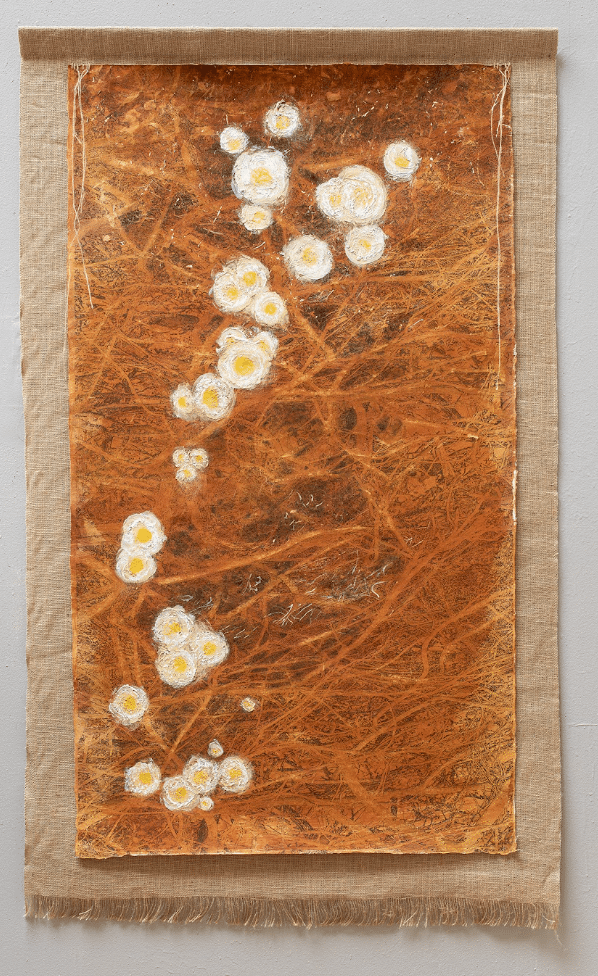
Colors, forms, textures, lines, and light converse as we see Salma Arastu’s works. This is not a story of her recent works or some previous series. But a continuous dialogue that has informed her works over the decades. Earth, light, fire, water, etherial lumination. Elements cognized by the viewers are presented to us by Arastu in a tangible form. Each work informs us of light, a color, or a form that we have once seen, but the artist re-presents them as strikingly emanating as she conjures her works. The earthly colors, illumination, and lyrical lines systematically vocabularize every painting, sculpture, and photograph. Every different medium that the artist explores carries a congruence in the visual language. A few select works from the past and current series are discussed in this article.
Hyderabad and Baroda: The Schools that formed the artist
Arastu’s quest to venture into the world of art led her to Jawaharlal Architecture and Fine Arts University (JNAFAU), Hyderabad, India, the erstwhile College of Fine Arts and Architecture, in 1967. A space that would nurture her as an artist and a thinker over the short span of five years. She recalls how Sayeed Bin Mohammed (1921-1982), her teacher, provided guidance, mentorship, direction, courage, and avenues for progress. Following this, she received the Andhra Pradesh Lalit Kala Academi’s scholarship to visit and work under the guidance of K. G. Subramaniyan. Baroda, in many ways, was a challenge. Moving from the known and established academic home of Hyderabad to a space that held a very different character. The smooth, abstract lines were challenged by the mentors, who demanded a precise explanation. This mental metamorphosis manifested in works like Smothered and an Entangled.
Smothered, literally suggestive of the struggles and the unforgiving grappling, is an abstract expression conjured through lines and light. Originally painted predominantly in blue and some other colors with white convoluting lines. It spoke of the silence, stillness, and turmoil engulfing the young artist. The Entangled work further provides a deeper dimension of the existential questioning the artist was living through. An etching, by nature, provides a stark contrast and play of light and darkness, the sharp and the blurred, and insinuatingly, the line connects and creates. The blob-like masses, be it the vegetal forms or the foreground, create a backdrop for the narration, rare for an abstract artist to explore. Sharp thorns and blurred shadows mark the distinction between proximity and directional depth. The line re-emerges. Not as meandering, but shaping into a quasi-abstract, nearly surreal human form. Maybe the human has a noose around its neck, as it floats above some ground, or does it just stand drained of hope? These two early works attest to the artist’s ability to employ the line as an elemental part of her visual and mental processes. Moving from Baroda, the artist’s marital life provided her with a wonderful experience of collaboration with her architect husband, motherhood, and an opportunity to move to another land, where the line emerged in a renewed form.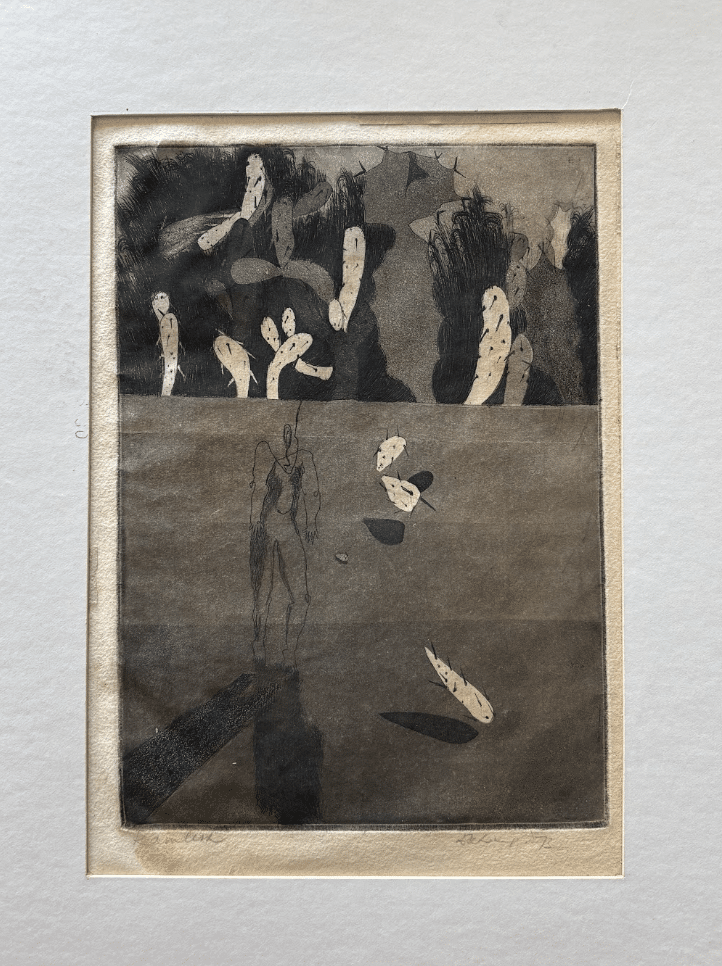
Calligraphy, Faith, and Vibrance
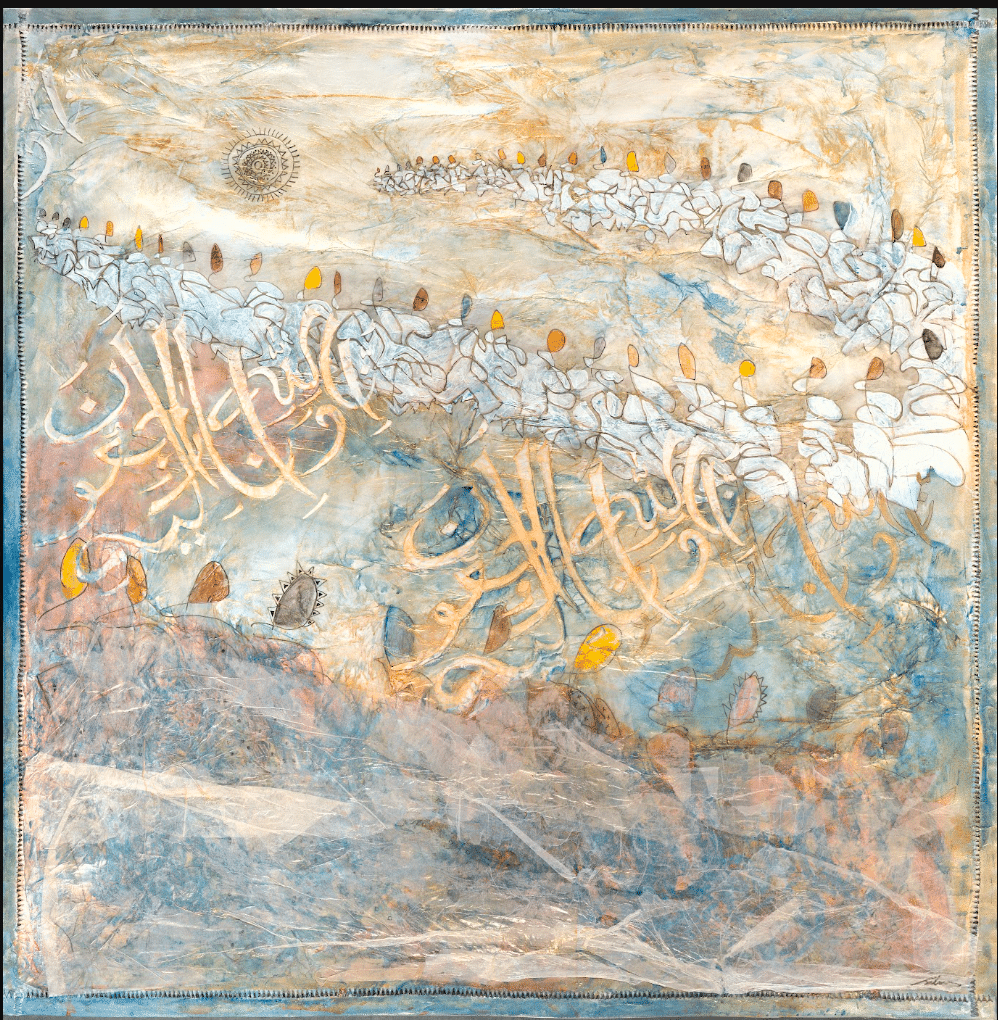
The birth of her daughter and son brought a renewed sense of purpose. The new family explored different locations as homes. Iran and Kuwait offered a plethora of architectural, chromatic, scriptural, and specifically calligraphic forms, as well as an understanding of an inter-faith approach to reading creativity. A sheer, dynamic, explosive energy is palpable in these works. Lines radiate, weave human forms, and create a collective coalition of masses. Mythological figures, ameboid forms, movement, and vigor characterize the works from the late 80’s and 90’s. Experimentation with different media, like wood boards, and the addition of impasto materials contribute to a strong tactile quality. On relocating to the USA, the family faced a wonderful span of explorations, until the tragic 9/11 incident. Their religious identity suddenly became a new filter through which they were read. At the same time, many assured the humanitarian approach, reassuring faith in personal and a protective, generous community regardless of one’s religious affiliations.

Based on 9/11, Arastu’s work titled Tragedy narrates the event, people’s reactions, and a consequent radical transition of the social fabric. Reading it as a personal tragedy and a sudden change in social holding, an imminent threat, and the larger picture of the humanitarian crisis do not escape the work. People, as collective forms, converge on the site of horror. This work is in the collection of the 9/11 Memorial Museum.
Nature: Roots and Restoratives
With a close correlation between her personal and artistic life, the artist has continuously sought refuge in understanding the forces of nature as restorative. Mycelial Flows merges aesthetic interests and a visual language with the biological force of nature. A network of earthy tones, dotted with nodular centers, emanates through the available space. Arastu reinterprets these as opportunities for humans to connect constructively. Further, after the global isolation due to COVID-19, the artist sought to create a community that would help people hear and heal. Thereby, founding a not-for-profit organization, Oneness Project, focusing on healing people through creative practices. The organization received a grant from the Alameda Arts Commission for its wonderful work.
During a meeting, the artist wonderfully articulated her process and identity as a creative practitioner as follows: “More important than style is intention. Every series explores the same essential idea: the interconnectedness of all life. Whether I am painting human communities, Arabic calligraphy, mycelial networks, microscopic organisms, or the waters of the Bay, I seek to reveal the invisible relationships that bind us to one another and to the living world.”
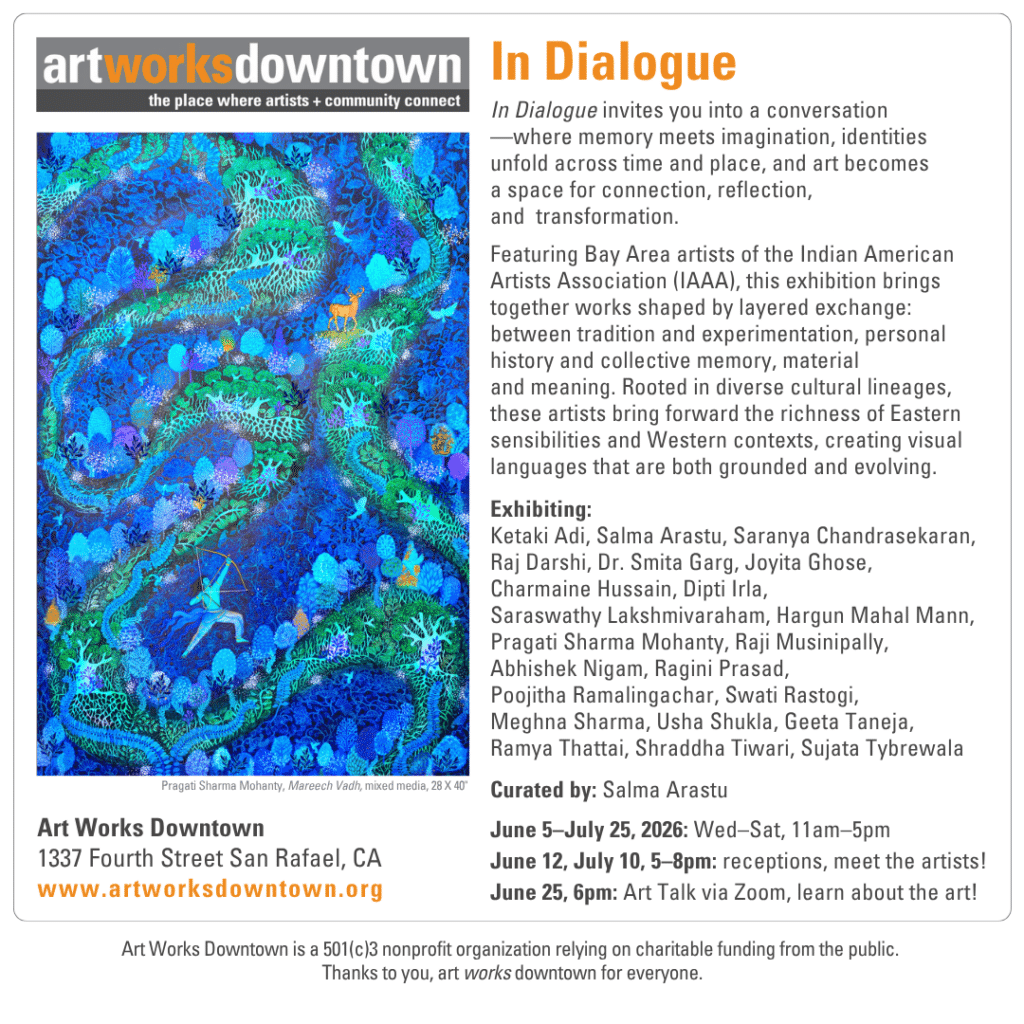
Her recent curatorial project, titled In Dialogue, features artists from the Indian American Artists’ Association. The show is on till July 25 (details in the link pasted below).
Important links:
Salma Arastu’s website: https://salmaarastu.com/
In Dialogue show: https://www.artworksdowntown.org/current-gallery-1337
Oneness Project: https://onenessprojects.org/