The Courage to be Curious in India’s AI Race
September 24, 2026
In 1893, on a ship sailing across the Pacific, a monk met a businessman. Both hailed from an India that was not yet free. As the story goes, the businessman shared his plans to bring manufacturing to India. The saint encouraged him with a grander vision: Why stop at that when India could also develop the scientific knowledge behind it?
The monk was Swami Vivekananda. The businessman was Jamsetji Tata, who went on to establish the Indian Institute of Science (IISc). Today, it is one of India’s leading research institutions.
Put yourself in their shoes for a moment. Imagine the immense courage it takes to invest in deep scientific research when the odds are completely stacked against you. To make such a monumental decision when the country was stripped of its resources and lacked even basic freedom to determine its own future.
Today, as India has entered its 80th year of independence, we are facing a similar decision-point. For years, a narrative has slowly taken root: that our country cannot produce breakthrough innovation, and more importantly, that we should not waste money trying.
The cost of this self-doubt is now becoming painfully clear. The rest of the world is currently making drastic investments in research to prepare for the upcoming waves of the AI revolution. India, on the other hand, is missing the movement of public, private and philanthropic capital required to move the needle. OpenAI spends more on research in a single month than our country’s five-year national AI budget. As a result, India is producing just ~1% of the world’s patents and leading conference papers in AI.
Our time has come to fix this.
Unlike a pre-independence India that was uncertain and restrained, the India that exists today is sitting on a massive advantage. The country is filled with incredibly ambitious and capable AI research talent.
This isn’t just blind optimism. I have spent the last three years traveling across the country studying AI researchers, and you truly cannot predict where brilliance will pop up. They are sometimes diaspora talent who’ve come back to India, now publishing papers at world-class conferences. Other times, they are open-source contributors shattering the myth that India doesn’t initiate innovative projects. Or they are founders of highly experimental startups, choosing to walk away from quick revenue to cultivate research-first cultures instead.

Diaspora-India AI researcher meetup in South Korea (ICML conference)
What is truly incredible about Indian AI researchers is that despite having few local examples to model themselves after, they are relentlessly willing to put in the work to be the first. They don’t mind building communities from scratch or proactively bridging the gap to connect with their global peers. They are literally creating the ecosystem they deserve on their own.
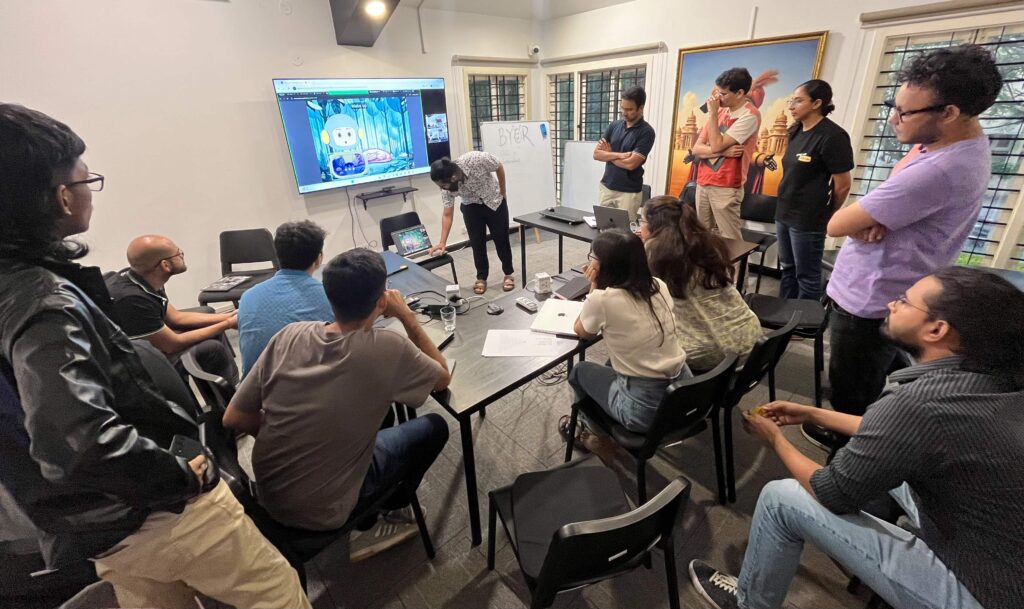
AI researcher community gathering in India
We are now more than three years past ChatGPT entering the public consciousness, and we could soon be approaching a new era in which AI could become recursively self-improving. The pace of this shift means that countries that fail to build a deep understanding of the technology risk being left behind. The prevailing playbook assumes winning in AI requires concentrating resources in a few hands. Instead, India can play a different game: rapidly jumpstarting its AI ecosystem using its single greatest competitive advantage, its people.
Our fastest path forward is to activate our exceptional researchers, wherever they are. That means enabling our research funding infrastructure to be fast and flexible such that it moves at the speed of the technology. This will enable widespread experimentation of niche ideas from novel architectures and compute-efficient models to AI for scientific discovery . We would simultaneously need to make it easier for ideas to jump across the evident gaps in how researchers, institutions, industry and funders connect today. As this work produces breakthroughs, amplifying those wins can attract more investment, creating a virtuous cycle that steadily strengthens India’s ability to build frontier capabilities.
India has never lacked curious minds. Perhaps what we need now is the courage to back them.
About the Author
Namrata Rajagopal is the CEO of Exception Raised, a non-profit that accelerates exceptional AI research talent in India. She was a Project Leader at Boston Consulting Group and a published author on AI at Harvard Business Review and Fortune.
She can be reached at namrata@exceptionraised.com
References
https://www.pib.gov.in/newsite/erelcontent.aspx?relid=28807®=48&lang=2
https://www.ft.com/content/e15b0d7e-ff6b-4f16-ba7a-4068feddb828?syn-25a6b1a6=1