Being a rice farmer in tribal Odisha means just one season of rain-fed cultivation and the need to migrate to the South or West of the country for employment. The migration leads to a negative spiral of events – labor shortage in the village leading to lower income and eventually, farming completely stopping.
The life of a dairy farmer is not any better. Fodder shortage is aggravating due to steady growth in the number of cattle and this has led to input costs shooting up. Low milk output and low-fat content because of the input issues have meant low milk prices. Together, cattle owners find it increasingly harder to make ends meet.
While these are two huge and different problems, Bimal Lakra, from the tribal majority district Sundargarh of Odisha, was able to connect the two during COVID by talking with many of the stakeholders. Gangpur Ventures, a for-profit social business was the result of his insights on the issues and iterations on the ground to come up with a simple and effective solution.
What does Gangpur do? They work with paddy farmers to grow corn during the non-rice season and buy the entire crop – including the green matter. It is processed in a decentralized way at community-run centres to create ‘silage’, which is fodder made from green foliage. Gangpur purchases and sells these to dairy farmers. Silage has been shown to improve milk output, fat and SNF (solids not fat) content, boosting revenue. The fodder is also cheaper compared to those transported from other States due to reduced transport cost, thanks to local processing.
The venture has perfected the silage making process and the steps to ensure farmers are able to grow and harvest at the right time. They are scaling their operations and have other results to show early success. Their business is profitable, and they have been able to add 2.7 times more income to 350+ rice farmers in 27 villages. Gangpur has set up three processing plants and supplies 3,000 tonnes of fodder annually.
While this is the ‘brain’, at their ‘heart’ the work is about building a rural economy where communities own the value chain – something that is not captured in the numbers. Gangpur is working on other allied activities to create a full stack solution that addresses the needs by starting with what products the communities are able to offer. Bimal is also the founder of Sarvodaya Social Development Foundation, a non-profit working on grass-root mobilization through farmer producer organizations, to promote heritage food, handicraft and culture in the tribal regions.
Gangpur is supported by Villgro Innovation Foundation through a first-loss guarantee in March 2025 for a working capital loan from Nabkisan Finance. Access to money-on-the-tap has been a relief as the business has high seasonal cash needs. Gangpur has been availing this credit line and plans to expand in the current season that starts in December.
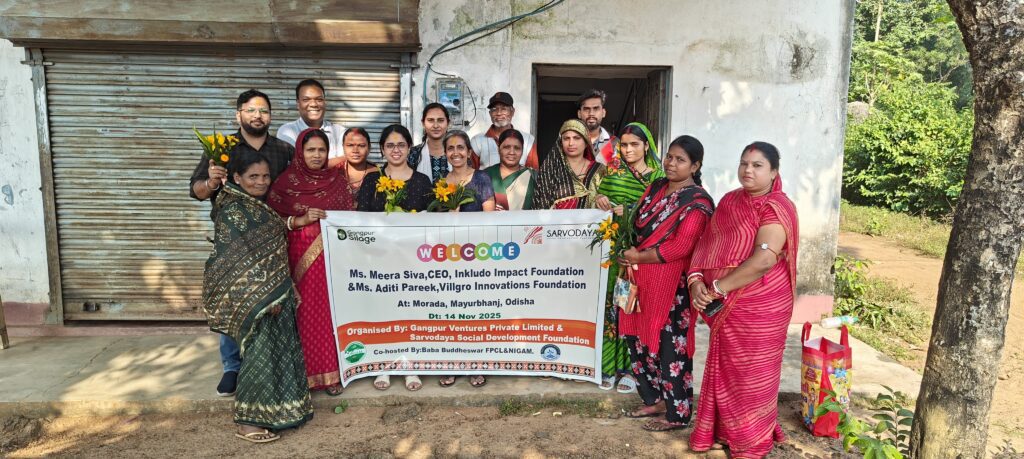
In November, our team from Villgro and Inkludo Impact Foundation visited Mayurbhanj near Simlipal National Park where work was about to start. The farmers – all women – gather to share why they want to explore this. The discussions validate the need for income stability and the solution that addresses their lack of resources to market what is produced.
The women say that labor costs have been skyrocketing and ask for help on agri tools. Gangpur works with farmers to rent drones, harvesters and other equipment and that is a big plus for them. One woman shares her worry on the land ‘going bad’ by growing corn, as only paddy was cultivated in their fields forever. Sarvodaya employee Sanghamitra explains crop rotation and how maize actually helps the soil’s fertility and gives examples from other villages where rice yield improved.
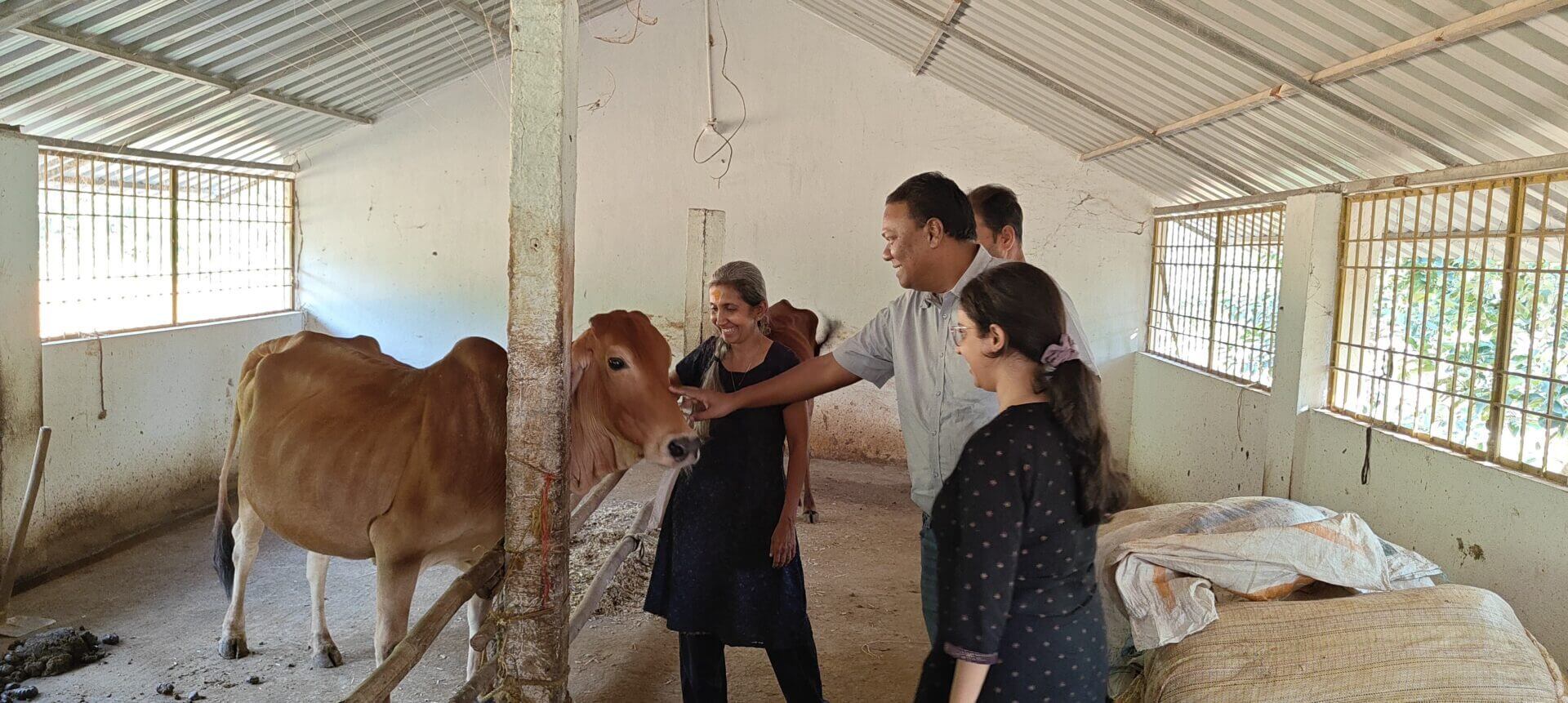
We visit Abhishek Mohanty, a dairy farmer who used to work in the fertilizer factories at Tuticorin near the Southern tip of India. He returned during COVID and has taken up farming and recently added cows. His motivation? To be with his family of growing young children and ageing parents. He has been buying silage for his cows and is now planting corn to produce it locally. This model – of ultra-local growing-processing-usage with nano-scale processing unit at village level – is the one Gangpur is working on for the long-term (it supplies primarily to medium and large dairy farms currently).
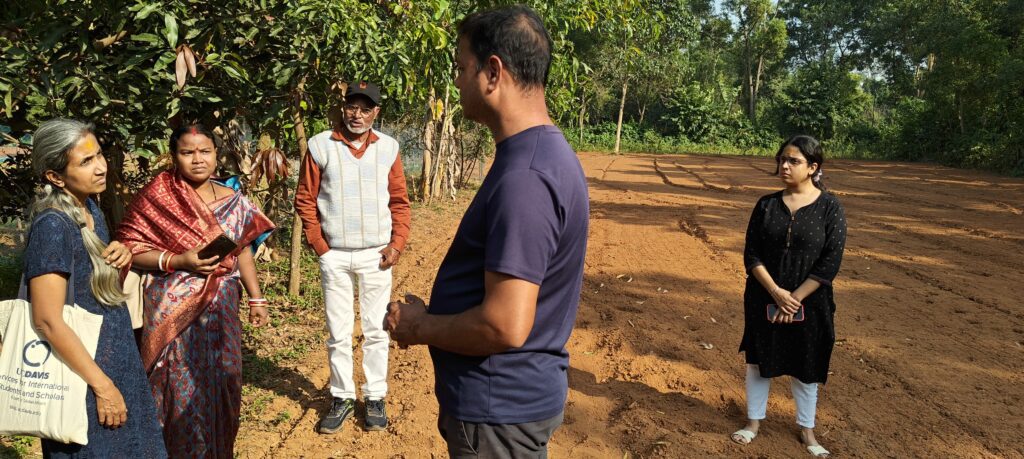
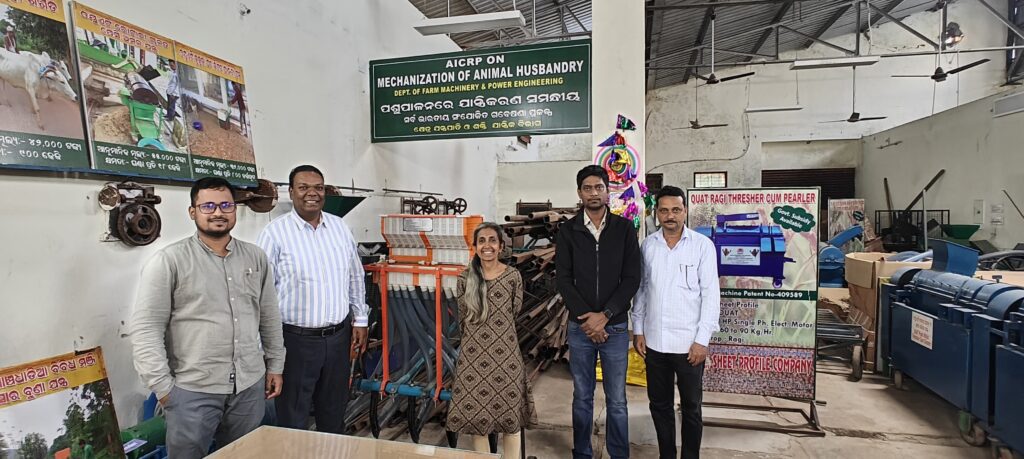
We met Professor Dr. Partha Sarathi Swain at the Odisha University of Agriculture & Technology who is also working on simplification of farm tools. He showed us a simple tool to plant corn seeds. Gangpur plans to take it to farmers soon. The University’s incubation program will also measure the yield improvement in indigenous cattle breeds using Gangpur Silage. The engineering team will also be looking at designing a low-cost tool for silage harvesting and on field processing and recommend ways to measure crop maturity easily to ensure the highest quality for harvest.
We also met a government official who heard Gangpur’s founder for the first time. After he realized this was not a non-profit, he asked for a ‘business model that will work even after government schemes stop’. He was very convinced on the value of silage and spoke of various programs in the works to increase cattle and silage production. He offered to ‘talk to the ministry for help such as access to land’ and ‘work together to create awareness among dairy farmers on silage’. His one advice to the founder stood out – ‘think like a businessperson’.
The next day, as I travelled in a tourist car from the famous Chilika Lake to Puri, the drive was slow with frequent stops. I looked out and saw many cows on the road. “They sleep here at night as they don’t have a shed”, the driver says. Hopefully with affordable access to silage the cow owners can provide a safe home for them; the tourists and their drivers can reach home early too.