


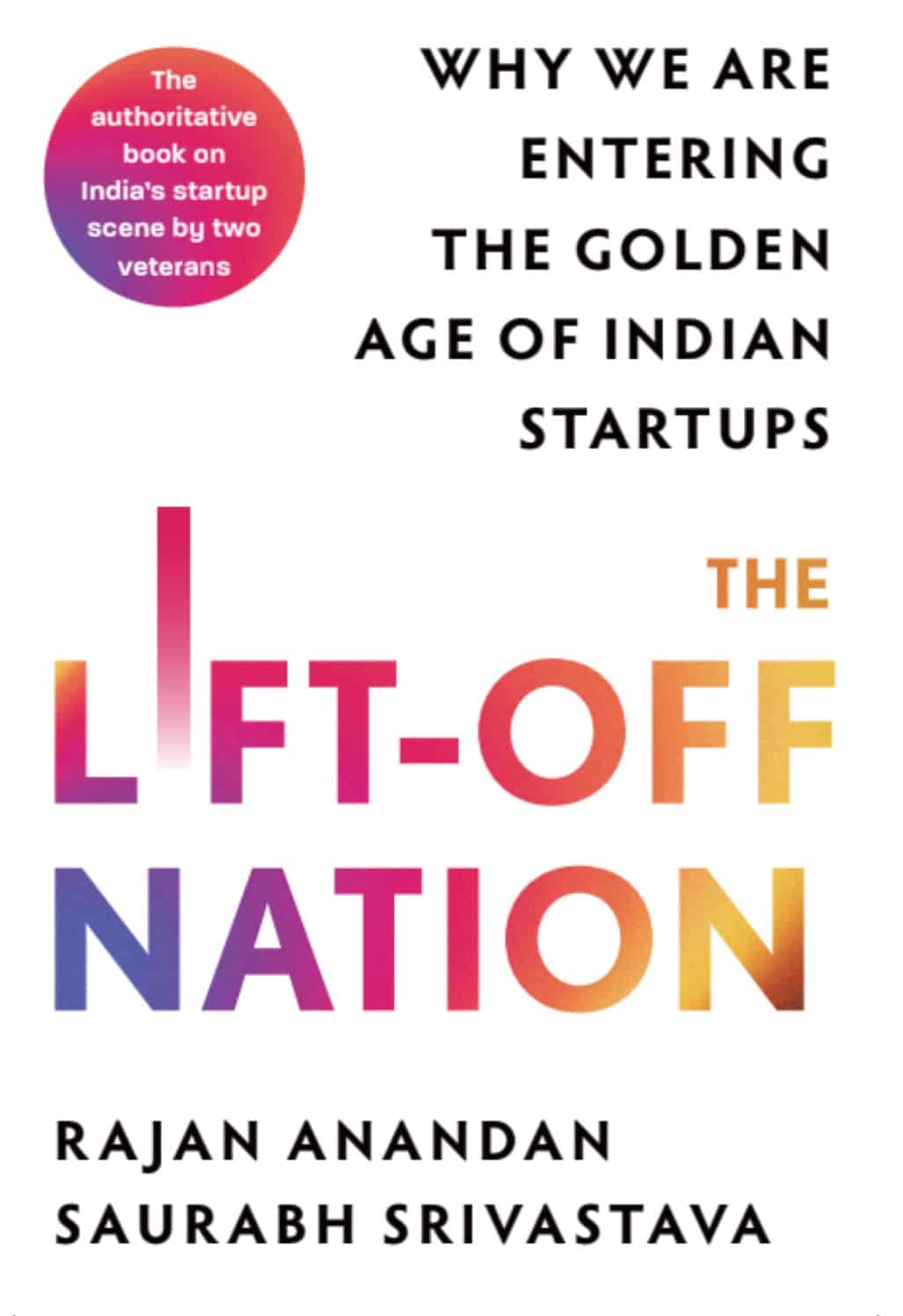
Once upon a time, India produced about a quarter of the world’s economic output. It is usually invoked with nostalgia, as a story about something that was lost. When we started writing this book, we wanted to treat it instead as a question: what would it take for India to get there again?
The more founders, investors and policymakers we spoke to, the clearer the answer became. A large part of that journey runs through India’s startups.
We came to this question from different places. One of us, Saurabh, has spent decades building companies and institutions that helped shape Indian technology: NASSCOM, TiE and the Indian Angel Network. The other, Rajan, spent years running Google, Microsoft and Dell in India before moving into venture capital at Peak XV Partners. We have both been part of India’s technology and startup story for decades. We decided to write this book because the evidence persuaded us that India had reached a genuine inflection point.
Consider one such piece of evidence: Within a decade, the combined valuation of Indian startups has crossed $400 billion. India’s IT services companies, the industry that first put Indian technology on the world map, are together worth about $325 billion. Building that industry took 35 years.
For one of us, this comparison is personal. Those IT services companies were the pride of an earlier generation, and we helped build some of the scaffolding around them. Seeing a newer ecosystem overtake them so quickly does not diminish what came before. It shows how much faster the next chapter is moving.
India is now the third-largest startup ecosystem in the world by number of startups, behind only the US and China, and the fastest-growing. And we are convinced that this is only the beginning.
Why so? Because for the first time in India’s history, five forces, that provide fuel to startups, are converging at the same time.
First, world-class talent is now starting up. A new generation of founders has been trained inside India’s first wave of “academy” startups – companies like Flipkart, InMobi and Freshworks – that taught thousands of people how to build, scale and, importantly, fail fast. Others are starting up after working at global scale inside the world’s largest technology companies. These founders are drawing on a much deeper pool of experience than the founders of previous generations could.
Second, India is witnessing a Cambrian explosion of opportunities across sectors. Startups once clustered around a handful of consumer categories. Today they are emerging across financial services, healthcare, space, advanced manufacturing, AI, defence, semiconductors and other core sectors. Some are building businesses that would have been difficult to imagine in India even a decade ago.
Third, ambition has changed as increasingly, Indian founders are building for the world from day one. Consider this: In 2025, around 40 per cent of new seed-funded startups were building for global markets from the very outset. The question for many founders is no longer whether they can build a large company in India. It is whether they can build a global company from India.
Fourth, capital is available at a scale we have never seen before. Venture funding has grown five-fold over the last 12 years. Just as important, India’s public markets are now open to startup IPOs. A founder or early investor can see a credible path from the seed round to a public listing.
Fifth, India has a supportive, pro-startup government. Regulatory reform and digital public infrastructure have been powerful accelerants. Aadhaar and UPI are now studied and emulated around the world. They have given Indian startups foundational rails that would have been unimaginable a generation ago.
What matters is not any one of these forces in isolation. What matters is that, for the first time in India’s history, all five are converging at the same time.
That is what makes this moment different.
What writing this book taught us
The biggest lesson was humility.
Even after a combined lifetime in this ecosystem, the more than 180 interviews we conducted kept showing us how much we had not fully appreciated: how much the founder playbook has matured, how much further ambitions have reached, and how quickly capabilities that once seemed exceptional are becoming commonplace.
We were also struck by how much of India’s startup story is still being written. The ecosystem is no longer confined to a few cities, sectors or types of founders. New companies are emerging in areas where India had little or no startup presence a decade ago. And many of these founders are attempting things that would once have required them to leave India.
We also learned that the most useful thing a book like this can do is replace anecdote with evidence.
Debates about Indian startups tend to swing between euphoria and gloom with every funding cycle. We wanted to step back from the headlines and look at the structural picture: the data, the people and the companies that show where things are actually heading.
The road ahead
We are not naïve about the challenges. Building global companies is hard. Capital will tighten, companies will fail and the ecosystem will go through cycles and corrections. India still has significant work to do on R&D, ease of doing business and regulatory predictability.
Take R&D, for example. It remains one of India’s biggest Achilles’ heels. India spends just 0.65% of its GDP on research and development, compared with 2.6% in China, 3.5% in the US and 6.4% in Israel.
India needs to raise this to at least 3% of GDP, with the government and private sector each contributing roughly 1.5%. Without that investment, India risks losing companies, intellectual property and, ultimately, its human capital to economies that invest more aggressively in innovation. We simply cannot afford that.
The government has recognised the urgency and taken two important steps. The Anusandhan National Research Foundation (ANRF), inspired by but broader in scope than the US’s National Science Foundation (NSF), is intended to strengthen the country’s research ecosystem. The $11 billion Research Development and Innovation (RDI) Fund is aimed at catalysing private-sector investment in R&D.
There is plenty of work to be done but we have never been more confident about the direction.
India once accounted for a quarter of the world’s economy. We wrote this book because we believe that, powered by its startups, it can do so again.
To reach the authors, use the contact form at lift-offnationbook.com