Where CEOs Rise and Children Cannot Read: India’s Quiet Education Crisis
August 5, 2025
How a rural innovation is addressing the foundational learning gap through local teachers, contextual curriculum, and a child-first philosophy
“Be the change that you wish to see in the world.” — Mahatma Gandhi
I have never studied abroad — only been a witness to India’s paradox. On one hand, our alumni lead Silicon Valley, our engineers and management graduates run global corporations, and our students ace international exams. And yet, a quieter, more troubling truth persists — millions of children in India cannot read or count at grade level.
This gulf — between the India that builds satellites and the India where a ten-year-old cannot subtract — is not just educational. It reflects the growing economic and social divide in our country. Addressing this gap has become not just my professional focus but also my personal calling.
The Crisis We Don’t Talk About
According to the ASER 2023 report, more than 50% of Class V children cannot read a Class II-level text, and barely 22% of Class III students can solve a simple subtraction problem. This is not just a COVID-19 after-effect — it’s a systemic failure.
Almost a quarter of primary teachers in India lack formal qualifications (NIEPA), and even those who are trained rarely receive support aligned with modern pedagogy, inclusive practices, or digital tools. The curriculum itself remains rigid and disconnected from children’s local realities — making it especially irrelevant for rural and tribal communities.
Reimagining Education: Lessons from Rural India
When I began working at Nanritam’s Filix School of Education in rural Purulia, West Bengal, I saw first-hand how education could be reimagined — especially for children who are often first-generation learners. Inspired by Finnish play-based pedagogy, we built classrooms where children learn through stories, songs, games, and hands-on experiments.
We adapted the curriculum to local contexts and introduced STEM labs (with Infosys), foundational economics, and even design thinking, while building collaborations with international universities like San Diego State and IIT. Slowly but surely, the joy of learning returned to our classrooms — and so did children’s curiosity and aspirations.

Education for All: A Grassroots Revolution
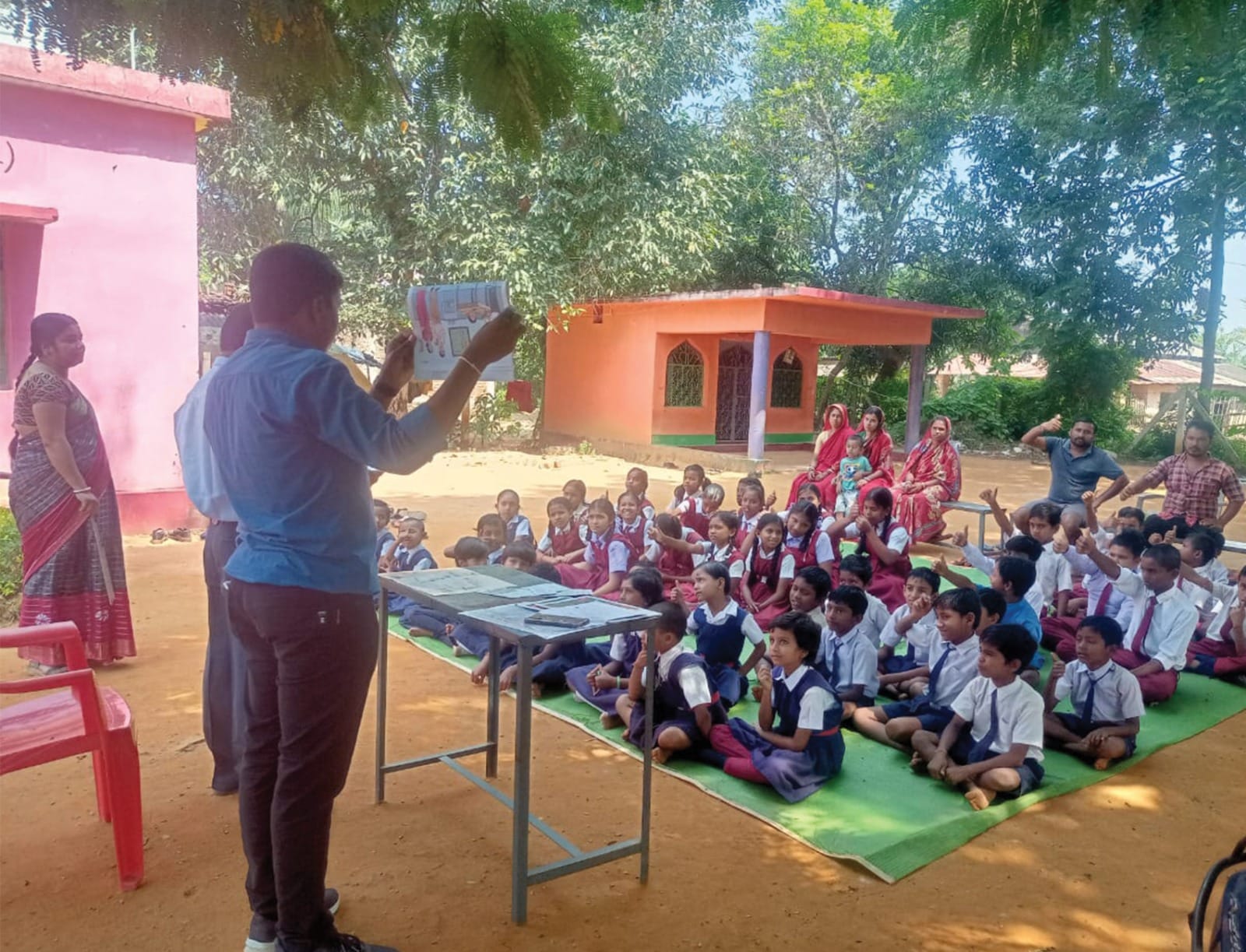
The pandemic pushed us to think bigger. In 2021, we launched Education for All (EFA) — a community-driven initiative that trains local women as teachers to bring contextual, child-centred education to underserved areas.
In just two years, we’ve trained over 4,500 community teachers, reaching more than 125,000 children across West Bengal, Ladakh, Meghalaya, Jharkhand, and Bihar. EFA’s strength lies in its simplicity: teaching kits include books, games, phonics-based guides, and low-tech support that even works in classrooms without electricity or internet.

The Women Behind the Change
I still remember meeting Chandra Sardar, a homemaker in a forested village of Bankura, who now runs an EFA centre where 30 children learn amidst a landscape often visited by wild elephants. Or Sipra Das Maity, who turned a clubroom in Kolkata into a safe space for children of domestic workers to learn instead of loitering on railway tracks.
These women — and thousands more — are the quiet revolutionaries who show that education begins not with standardisation, but with empathy.
Why It Matters — and Why You Can Help
We are not inventing new ideas. Nobel laureates Amartya Sen and James Heckman have shown us, with data and conviction, that early childhood education — especially for disadvantaged communities — delivers the highest return on human capital investment. What we are doing with EFA is putting these insights into practice in India’s most forgotten geographies.
EFA aligns with the United Nations’ Sustainable Development Goal 4, which calls for inclusive, quality education and lifelong learning for all. But it also reframes “quality” as something more profound: the lived experience of relevance, joy, and growth — no matter where a child is born.

A Call to the Diaspora
To those of you in the diaspora, this is more than a story. It is a mirror — and a mandate. While many of us have benefited from the finest education systems, millions of children in our homeland still wait for the most basic tools: a trained teacher, a story they can understand, a classroom that sees them.
EFA is not a charity. It is equity in action. And you can help — by connecting, funding, mentoring, or simply sharing this story. Because when we help India’s children learn, we help India remember what it means to rise — together.
About the Author

Priyanka Ghosh is Academic Director at Nanritam’s Education Unit, an alumna of the Indian Institute of Management Calcutta and Jadavpur University. She teaches English Literature, is certified in Finnish pedagogy, and develops curricula for the Education for All programme — advocating for equitable, context-driven learning rooted in local realities.