Prithibi by Sramana Mitra
September 29, 2026
What does the Bengal School evoke for a connoisseur of Indian Art? Abanindranath Tagore, Nandalal Bose, Jamini Roy, Ramananda Bandopadhyay. Depictions of mythology in tender, lyrical tones. Indigenous rural scenes. A vocabulary created in opposition to Twentieth Century European Art.
I was born into an old Kolkata family, and raised immersed in Bengali cultural traditions. Rabindranath Tagore was woven intricately into our lives through literature, poetry, music, dance and art. Each Saturday morning, I visited Ramananda Babu at his house. I painted under his tutelage, the long shadow of Shantiniketan hanging over us.
My parents had houses in Shantiniketan. From our Gurupalli home, we could walk to Gaur Prangan, Kala Bhavan, Chhatim Tala and Patha Bhavan. We lingered at Kalor dokan and Nabadwiper dokan, haunts of Tagorean intellectuals, in full acquiescence with the Biswa Bharati vibe. The countryside of Bengal was the first paysage I saw through the eyes of a landscape painter.
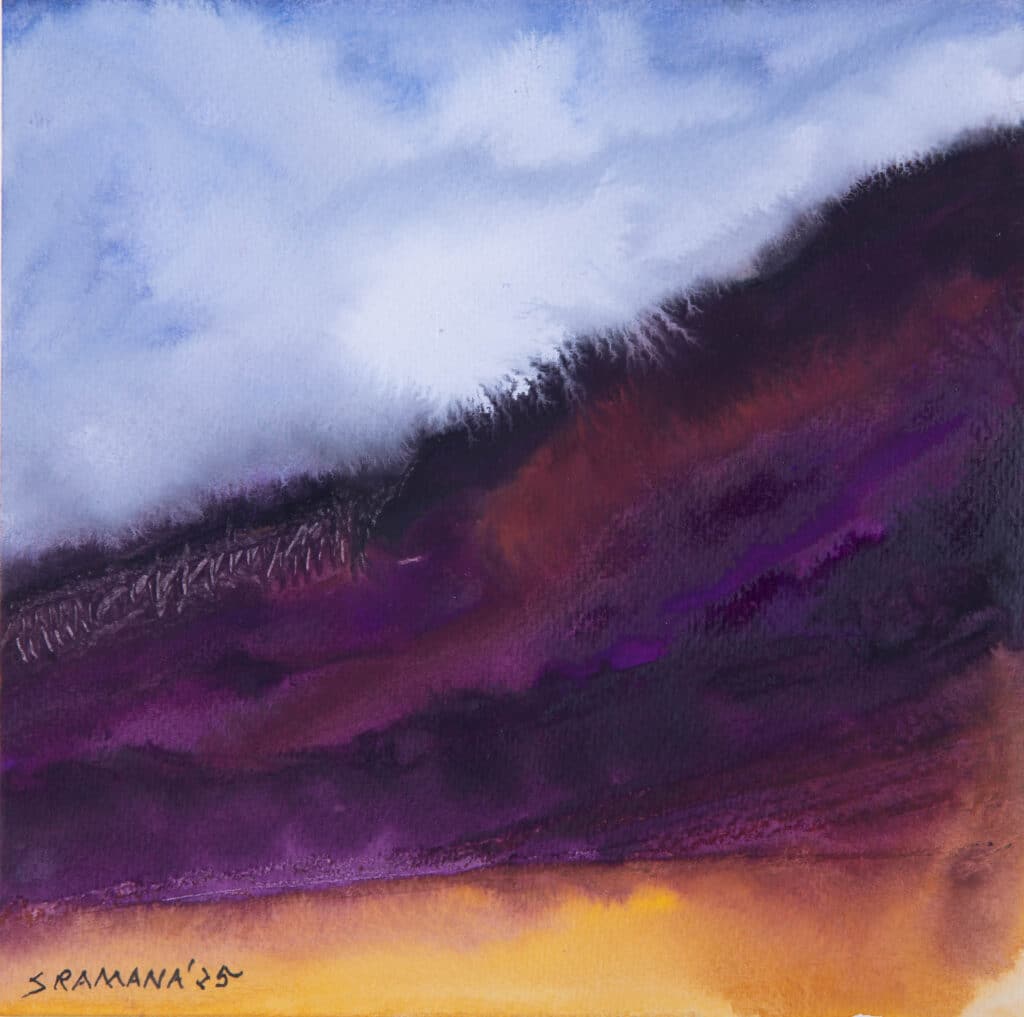
My mashtarmoshai, however, shielded me from becoming a replicator of the prevalent Bengal School tendencies. As such, even though I am a Bengal school painter, Monet, Cezanne, Bonnard, Matisse, Diebenkorn have all found unhindered channels into my psyche.
Abstraction was already settling into my brushes by 16. And at 18, I flew halfway around the world to a small New England college town in Western Massachusetts. My palette changed within six months. I experienced the rust, russet, yellow, orange and red of fall foliage. Soon after, the shades of white that eloquently usher in winter to a part of the world that remains vivid in my memory thirty years later.
The American West – California, Montana, Wyoming, Utah and Colorado – offered yet another range of colors and sceneries as I eventually settled in Silicon Valley. My high-flying career as a tech entrepreneur put my brushes away for years, until Covid offered the gift of time to return to them.
I married a Belgian. London, Paris, Brussels and numerous other European museum capitals opened up opportunities to study Art up close. Pierre Soulages’ centenary exhibition at the Louvre in 2022 opened up an entirely new way of looking at the color black.
As we traveled through the Scottish Highlands in 2023, my style already formed, I recognized my own paintings in the landscape. Tagore’s lines wafted in: Biswarooper khelaghore kotoi gelem khele. Aporup ke dekhe elem duti noyon mele.
In me, Tagore’s lines often rise spontaneously in response to beauty. I am an unapologetic worshipper of beauty. Even as I live in an era of darkness, fully aware of the geopolitics of Trump, Putin, Netanyahu and the rest, even as I depict war, hurricanes, wildfires, I do so without violating my natural relationship with aesthetics.
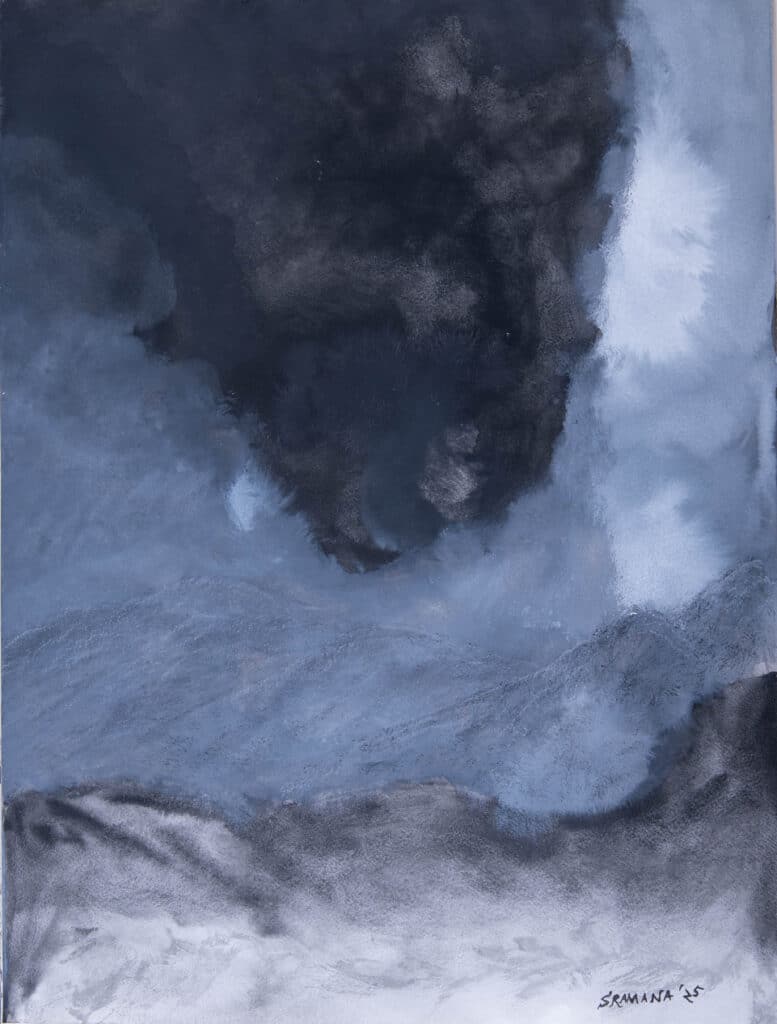
That makes me not a contemporary painter enamored with the fashionable gimmicks of anti-beauty.
That makes me a Bengal School painter largely at peace with the world.
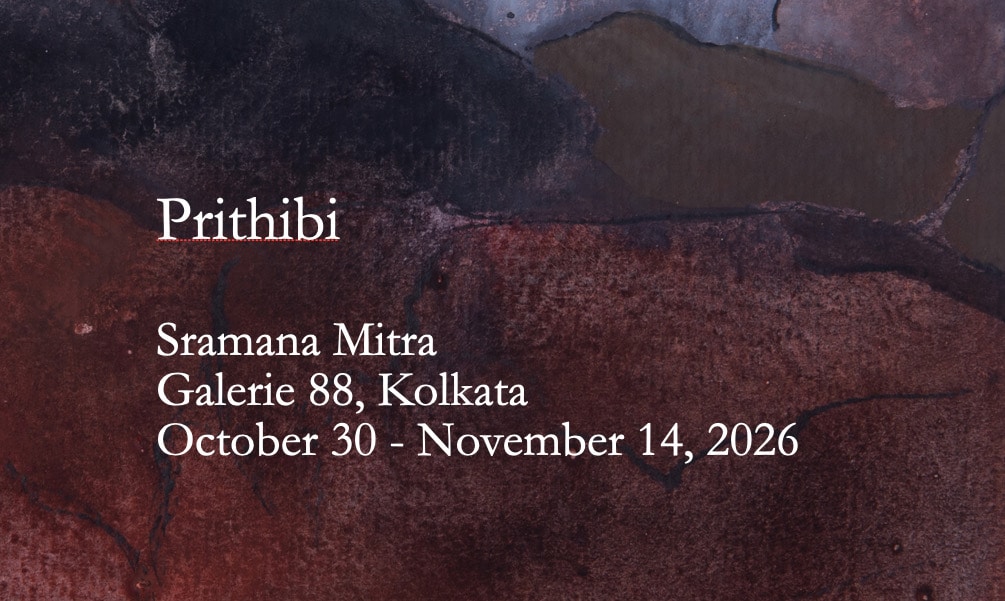
This exhibition is called Prithibi in acknowledgement of that acceptance. That harmony.
With self.
With nature.
With the universe.
About the Author

Sramana Mitra is the founder and CEO of 1Mby1M (One Million by One Million), the first global virtual accelerator for technology startups. She is a serial entrepreneur in Silicon Valley, an MIT Computer Scientist, and a painter. Her upcoming exhibition, Prithibi, will be held at Galerie 88, Kolkata from October 30 to November 14, 2026.