Lessons from a Life’s Journey
July 14, 2026
A conversation with Raj Gupta — from IIT Bombay to the helm of a global enterprise — on leadership, mentorship, and what it means to live a meaningful life
In conversation with Mukul Pandya
When Rajiv L. Gupta — Raj to the many who know him — arrived in the United States in the spring of 1968, he intended to stay for two or three years. He had a fresh degree from the Indian Institute of Technology, Bombay, a fellowship to study operations research at Cornell, and an arranged marriage to Kamla that was barely a week old. The plan, shaped by his parents’ wishes, was simple: gain some experience and return home to India.
He never did go back. Instead, Raj built a 39-year career at Rohm and Haas, the Philadelphia-based specialty chemicals company, rising through 13 different jobs under 17 bosses to become its chairman and chief executive in 1999. Over the following decade he led one of the most admired transformations in the company’s history, and in 2009, in the depths of the global financial crisis, he negotiated and held together its $19 billion all-cash sale to Dow Chemical — a deal the industry press called “the deal of the century.”
Yet what Raj himself returns to, again and again, is not the scale of the deals or the size of the titles. It is the people who shaped him, the values his parents lived, and the Rohm and Haas colleagues he mentored who have gone on to lead companies of their own around the world. “I am always reluctant to self-brag,” he told me when we began this project. So we agreed to do it as a conversation instead. What follows is drawn from a series of exchanges about his journey — lightly edited, in his own voice.
Formation: An Outsider’s Education
You’ve said your parents practiced their values rather than simply preaching them. How did that shape you?
Growing up, we witnessed that many — perhaps most — of my father’s peers had expensive cars, sent their children to high-priced boarding schools, kept beautifully furnished homes, and vacationed at pricey resorts. Behind the scenes there were always conversations about how they could afford it. My father was a civil engineer in government service, and in a profession where corruption was common, he never took a single rupee in a bribe. By comparison, we lived within our means — a simple but very comfortable life. That example stayed with me.
You were one of six children, and the family moved often. How did those early years prepare you for what came later?
In my first 15 years we lived in five cities across Uttar Pradesh, and I changed schools many times. That taught us to adapt, to make new friends, and to stay close as siblings. One of the most painful events came in 1954, when I was nine. The six of us ranged from three to ten years old when my father was diagnosed with encephalitis and hospitalized for six months at the Agra Medical College hospital. The older five of us were sent to live with our uncles; the youngest stayed with my parents. Even as a nine-year-old I worried about how we would survive if something terrible happened to him. He recovered, but he was never quite the same person again. My mother deserves enormous credit for keeping the family together and navigating challenges on so many fronts.
What I remember, too, is that the pressure at home was never about standing first in class. The focus was on all-round development, including sports. When my older sister finished at the top of her school in the statewide board exams, it quietly raised the aspirations of all of us. The combination of those early experiences made me comfortable and confident in my ability to adapt, survive, and thrive.
Two institutions stand out in your account — BNSD in Kanpur and IIT. What did they teach you?
My four years at BNSD in Kanpur, from the eighth to the eleventh grade, were transformational. Our home was four miles from school, and I biked back and forth every day. BNSD was proud that, year after year, four to six of the top rankers among more than 100,000 students in the statewide high-school and intermediate exams came from our school. Looking back, there were a few reasons. They typically had a thousand students in each grade, divided into 25 sections, and they placed the top 40 or so in a single section. Two things came from that: you learned to compete, survive, and thrive in an intensely competitive environment, and you experienced the incredible dedication of teachers who pushed us to realize our potential, though they were paid very little.
My five years at IIT Bombay, from 1962 to 1967, were a step up, because now the competition came from the best of the best from around the country. I personally had to learn how to navigate coming from a state — UP — that was considered second-rate. The dedication of the faculty was very similar to what I had known at BNSD. There was another dimension as well: a year at Aligarh Muslim University, where more than 90 percent of the faculty and students were Muslim. As a Hindu, I was very much in the minority. We lived through a brutal Hindu–Muslim conflict in the fall of 1961 that shut the university down for a month. I finished at the top of my class and learned, once again, to adapt and stay focused — to survive and thrive while feeling like an outsider in my own motherland.
What did learning to compete with the very best teach you about talent and opportunity?
My biggest takeaways from BNSD, Aligarh Muslim University, and IIT served me well throughout my career. The first was not to become defensive or resentful, but to stay focused on my priorities, my purpose, and my principles. Each of us is eventually judged and accepted as an individual, not as a prototype of some consensus profile. I also learned to attribute bias to ignorance and a lack of personal experience rather than to ill intent. That conviction helped me navigate my personal and professional life across the US, Europe, and Asia.
The Making of a Leader
You came to America for two years and stayed 58. How did that happen?
My family’s background, on both my father’s and my maternal grandfather’s side, was formed by government service — both were civil engineers with lifelong careers in government. I studied engineering because my father had wanted to be a mechanical engineer. I enjoyed my five years at IIT Bombay and graduated second in my class, but engineering was never my passion. The trouble was, I had no clue what my passion actually was.
I came to Cornell in the spring of 1968 for a master’s degree in operations research, thanks to a fellowship that covered tuition and living expenses — and that gave me a way to come to the US. A week before I left India, I also had an arranged marriage to Kamla, who joined me at Cornell that fall. The plan was to find a job for two or three years and then return to India, because that was what my parents wished.
It was not the best of times to find work — the economy was soft — but I was fortunate to receive four offers, from IBM, Burroughs, Xerox, and Scott Paper, each around $12,000 a year. I chose Scott Paper, headquartered in Philadelphia, for three reasons: my only relative in the US, my father’s younger brother, lived nearby; we were expecting our first child and Philadelphia was the warmest of the options; and Scott sent a company plane for the interview.
Those two and a half years at Scott were wonderful. I solved real business problems, worked for Ashok Bakhru, an IIT Bombay alumnus four years my senior, and got to know the head of strategy, who later became CEO. It drew me toward business management, which led me to an MBA in finance at Drexel’s night school, funded by Scott. But my parents still hoped I would return to India, so I began looking for a finance role at a company with a presence there. That search led me to Rohm and Haas in November 1971.
And one mentor’s promise, in particular, changed your trajectory.
My analytical work consolidating the company’s global financial numbers caught some attention, and in 1973 I was made global cash manager, working for the treasurer — a man who would later become CFO, then head of Europe, then CEO, and one of my key mentors. One day, out of the blue, the CEO, Vince Gregory, asked to see me and offered me a role as his assistant, developing the company’s first five-year plan. I presented that plan to two hundred senior leaders from around the world. I was nervous beyond belief.
Then came the oil crisis of 1974–75, with prices quadrupling from two to eight dollars a barrel. From record sales and earnings, the company reported its first loss since going public in 1948. We worried about our ability to pay interest on time. It was during that crisis that I learned how to stay focused and calm, to exit businesses where we were sub-scale, and to watch how the CFO and CEO communicated transparently with the Haas family, who owned forty percent of the company, with other shareholders, and with employees. We stabilized the situation and entered 1976 well positioned.
Some years later I was offered the role of CFO of our UK operations — our largest business outside the US, but underperforming. Given the history of India and Britain, I was reluctant to move my family to London, and the UK was itself in an economic crisis. Vince Gregory had lived in the UK for a decade and was married to a wonderful English lady. He noticed my hesitation and made a promise that became a turning point. “Raj,” he said, “I know you are apprehensive, and I understand why. Here is the deal — go ahead, and if after six months you are not happy, call me and we will bring you back. I have full confidence that you will do just fine.”
In some ways, the rest is history. That move led to 15 years in Europe across six different jobs, then five years leading our Asian business, the building of a new platform in electronic materials, and eventually the CEO role. In all, I held 13 jobs under 17 bosses over 39 years. My mentors — Fred Shaffer, who recruited me; my two predecessor CEOs, Vince Gregory and Larry Wilson; and Dr. Basil Vassiliou, who led European operations — gave me their trust and unconditional support. I am deeply indebted to them. One other person I want to acknowledge is Dr. Karol Wasylyshyn, who worked as an executive coach with Rohm and Haas executives, including me, over two decades.
There’s a story you tell about a single, courageous question you once asked Larry Wilson.
I was visiting Philadelphia headquarters in the spring of 1993. I had been in Europe for 15 years, both our daughters were studying in the US, and I was beginning to wonder about my next move. Larry Wilson was a man of few words — if you asked him a question, you had better be ready for a straight answer. I asked him a simple one: “Larry, I just want to know one thing. Is my career behind me, or ahead of me?” He took a minute, and said, “If I wanted you to be CFO, I would have offered it to you today. But I have a different idea, and in any case, I see your career ahead of you.” That left me both excited and nervous.
A couple of weeks later he called to say the board believed Asia would be critical to the company’s future and that they wanted me to lead it. There were conditions: I would operate out of Philadelphia, where the important decisions were made, but Kamla and I would have full freedom to travel across Asia at company expense. It also brought us closer to our daughters.
Over the next five years, from 1993 to 1998, we traveled six months a year, from New Zealand to Japan, from Indonesia to India. We built six manufacturing plants in China, two in India, and one each in Thailand and Indonesia. In 1995 I was also given the global electronic materials business, then a single company with sales around a hundred million dollars. Through two acquisitions we assembled a global enterprise of three hundred million dollars in sales. Today those businesses form the core of Qnity, a New York Stock Exchange company (symbol Q) with sales of $4.5 billion and an enterprise value of $35 billion. By the time Rohm and Haas was sold, Asia represented thirty percent of our global sales and profits.
Through all of this movement — across countries, jobs, and continents — Kamla was your constant. What has her role been in your success?
None of this would have been possible without Kamla. She deserves incredible recognition for raising our family through the challenges of moving around the world — settling us into each new place, making friends wherever we went, and keeping us close to our extended family across every distance. She was my traveling companion, and she helped me build relationships with colleagues and customers in a way I never could have alone. And she did all of this while pursuing her own interests — playing the tabla, learning tennis and golf, and becoming genuinely good at them — and being an extraordinary mother while I was so often on the road.
She also carried far more than her share of our family’s hardest moments. She lost two of her sisters, both in their twenties, one in a car accident and one in a fire. She stood by me through my prostate cancer. When I count my blessings, I begin with her.
The CEO Decade — and the Deal of the Century
How did the CEO succession unfold?
In the fall of 1997, after a board meeting, Larry told me that I was one of three candidates to succeed him, with the board’s decision to come by the middle of 1998. The three of us knew each other very well, and we made a collective decision: we would stay focused on our roles and not play politics or undermine one another. We even met for dinner once a month, with our spouses, to maintain candor and friendship. On the Friday before the July Fourth weekend in 1998, Larry asked to see me and one other colleague late in the day. I went first, and was told the board had chosen me as chairman and CEO. My first call was to Kamla.
Your decade as CEO began with a bold and risky transformation.
In just six months, from the fall of 1998 to the spring of 1999, we transformed the company’s portfolio. It was well planned, and the board and management team were fully aligned, but we underestimated the external environment — the Asian crisis, followed by the dot-com bust. In that short period we made three acquisitions for a total of $5.5 billion, went from thirty-five to a hundred and five manufacturing sites, grew from ten thousand to twenty-three thousand employees, and took on $4 billion of debt, from a starting point of zero — all while the leadership was changing. We had sixty-four separate information systems, and our share price fell from the mid-forties to the mid-twenties in a matter of months.
It was a very challenging time, but because the board and the leadership team were so engaged in the key decisions, we were confident we could navigate through. I set three priorities: invest in one global information system; never compromise on R&D or on investing in Asia; and ensure positive cash flow. It took us two years, including divestitures, cost reductions, and frequent, transparent communication with employees, investors, customers, and the board. We were back on track by the end of 2002, and we had a great run from 2003 to 2008. Over its 60 years as a public company, Rohm and Haas delivered an average annual return to shareholders of 13.5 percent — among the top quartile in the S&P 500 — and over its last decade as a public company, from 1999 to 2009, it was the second-best performer among its S&P peers.
And then came the sale to Dow — forged at a premium just before the markets crashed. In your account for Harvard Business Review, you described keeping that deal alive as one of the hardest things you have ever done.
In November 2007, representatives of the Haas family trusts, which owned thirty-two percent of the shares, asked me to explore selling all or most of their holdings at a full and fair price. The timing was surprising. The board and I had perhaps naively believed that as long as John C. Haas, the founder’s son, was alive, no such request would come. We identified just three strategic buyers, and within weeks Andrew Liveris of Dow came to Philadelphia with an all-cash offer of $74 a share. Our stock was trading around $52 at the time; the highest it had ever been was $62. After the board fulfilled its duty to test the market, we announced the deal on July 10, 2008, at a final price of $78 a share. The shareholders were delighted, and the industry called it the deal of the century.
Then the financial markets crashed. A $9.5 billion joint venture that Dow had been counting on with Kuwait Petroleum collapsed, and suddenly Dow could not easily find the cash. Our contract was airtight and unconditional, our shareholders had approved it, and the board and I had a fiduciary duty to complete it. For months I lived a double life — only a handful of people knew the full picture — and I was getting emails at midnight asking, “Are you awake?” The answer was always yes. In August, entirely unexpectedly, I learned I had prostate cancer, which added a new dimension to the stress. A low point came when I passed out on a flight to Germany and had to be admitted for emergency care. I withdrew from day-to-day operations to focus on my health; my sole remaining responsibility was seeing the deal through.
We eventually had to file suit in Delaware to enforce the contract, asking the court to decide whether a company should be held to the terms of a deal regardless of external conditions. The whole world was watching. Less than a week before we were due in court, Andrew wrote to me: “Raj, should we give this one last try?” We met in New York, each of us bringing one respected board member to help. Dow found creative financing, persuaded the rating agencies to keep its investment-grade status, and on one of the lowest days of the year for the stock market, its directors signed off. In the end, we got the $19 billion. I left Rohm and Haas for the last time on March 31, and the deal closed the next day. It was a bittersweet victory. I had invested so much in building that organization that it was hard to let it go — though I took solace in knowing that most of the family trusts’ proceeds went straight to charity. The engagement of the board, and in particular of our lead director, Dr. Sandy Moose, was critical throughout the sale process.
My biggest takeaways from that decade are three. In a changing environment, a bold strategy is better than an incremental one, though it raises the risk significantly. The right talent and a focus on execution are critical to delivering results. And the trust of your key stakeholders is vital — it requires frequent and transparent communication, especially when the news is hard.
Mentorship, Legacy, and Giving Back
Mentorship runs through your whole story. What did you come to understand about it?
Mentorship never ends. A mentor can be a colleague, a friend, a family member, or a teacher. Looking back, my parents were my first mentors, then a professor at IIT Bombay, K.P.K. Nair, then my boss at Scott Paper, and several people at Rohm and Haas — my two predecessor CEOs, the CFO who recruited me, the head of our European business, and our lead director, Sandy Moose. True mentors do not just praise you. They are comfortable giving you honest feedback about what you could do better. They see your potential, but they also see what will hold you back from realizing it.
I owe my long board career to my mentors, beginning with Larry Wilson, who believed board experience would make me a more effective CEO and helped me onto my first two boards. Once I became CEO, the gates opened, and I ended up serving on fifteen public, five private-equity, and two private company boards. One of my greatest mentors was Jack Krol, the former CEO of DuPont, who brought me onto the Tyco and Delphi boards. Watching him lead a board was itself a profound education. From John Haas, the son of the founder, I learned the importance of preserving a company’s culture and values.
My own experience with mentors moved me to become one. That, more than any deal, is what I am proudest of: fifty-three Rohm and Haas alumni have gone on to serve as CEOs around the world — twenty-two at public companies and thirty-one at private-equity or private firms.
Beyond serving on public company boards, what has kept you engaged in your retirement?
Learning and sharing ideas and experiences is my passion, and retirement has given me the room to pursue it in several ways. One of the most rewarding has been my 17-year association with Steve Klinsky and New Mountain Capital. It has let me both contribute to and learn from an alternative way of building businesses — one focused on long-term value creation rather than financial engineering — and it has kept me close to how enterprises are actually built and sustained.
I have also been fortunate to have a close association with two Wharton professors, Harbir Singh and Mike Useem, and with Harvard Business School professor Lynn Paine. I teach in executive sessions on three topics: executing bold strategy through M&A, the changing role of boards, and leadership traits in a rapidly changing world. And writing — sharing my thoughts on these subjects through business magazines — remains of high interest to me. Some years ago I also documented my own story in a book titled Eight Dollars and a Dream: My American Journey, which began as a family history for my grandchildren and grew into something a wider audience found useful. In one form or another, all of it comes back to the same thing: passing on what I have been fortunate enough to learn.
Giving back became a passion and a priority after I retired. That led Kamla and me to establish our family foundation, Ujala, focused on education and healthcare and split equally between my country of birth, India, and my adopted country, the United States. Between our partners and our foundation (primarily Haas family and Klinsky family), we have contributed more than $40 million over the last 15 years. It was also a great honor to be asked to serve as commencement speaker for the 41st graduating class at IIT Bombay in 2003, and at Drexel’s LeBow College of Business in 2022.
A central message you want to leave with younger readers is that you don’t have to be a genius to lead a meaningful life.
That is the heart of it. You do not have to be an outlier or a genius to lead a meaningful, impactful life. Everyone has a chance. If anything, I would put it the other way around: excelling in school is not enough. Academic ability opens doors, but leadership calls for qualities that no examination measures — the capacity to bring out the best in others, to stay steady under pressure, and to earn the trust of the people around you. Accessible, values-based leadership looks like staying focused on your purpose and principles, treating people with respect, doing your best wherever you are placed, and being honest — the very things I watched my parents practice when I was a boy. Those things do not require brilliance. They require character.
Finally — how do you measure legacy?
Not by what I achieved. I measure it by the impact my Rohm and Haas colleagues have had around the world and the values they have carried forward, and by having raised two daughters with the freedom to pursue their passions — and the impact they are having in their own fields. One is chair of infectious diseases at Johns Hopkins and runs its global center for health; the other served as the nineteenth Associate Attorney General of the United States, the third-ranking leader at the Department of Justice, and now runs the Center on Law and Public Trust at NYU Law. If I am remembered for anything, I would want it to be that — that the people I worked with and the family we raised went on to do good in the world. That is a fuller life than any title or any deal could ever provide.
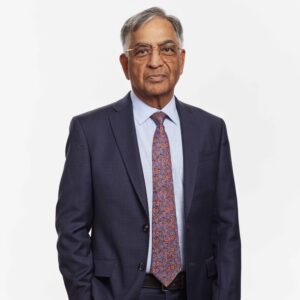
Raj Gupta is the former chairman and CEO of Rohm and Haas Company. He has served as a director of 15 public companies, including as Lead Director or non-executive chairman of four Fortune 500 companies — Avantor, Delphi/Aptiv, Hewlett-Packard Inc., and Arconic — and as a director of DuPont and Tyco, among others. He has also served on the board of The Vanguard Group, as well as on the boards of several private-equity and private companies. He is co-chair of the board of advisors of the Johns Hopkins Gupta-Klinsky India Institute and founder of the Raj and Kamla Gupta Governance Institute at Drexel University’s LeBow College of Business. His account of the Dow transaction, “Rohm and Haas’s Former CEO on Pulling Off a Sweet Deal in a Down Market,” appeared in Harvard Business Review in November 2010.
Mukul Pandya is a former associate fellow and consulting editor for Saïd Business School at the University of Oxford, and founder, former executive director and editor in chief of the Knowledge@Wharton Network.