I have spent much of my adult life thinking about ancient India — not as a place of myth or nostalgia, but as a civilisation that produced some of the most rigorous, original thinking the world has ever seen. Yet for most Indians — whether living in India or across the world — this knowledge remains locked away in Sanskrit, inaccessible and therefore invisible.
That invisibility troubles me. Because the loss is not just cultural. It is intellectual.
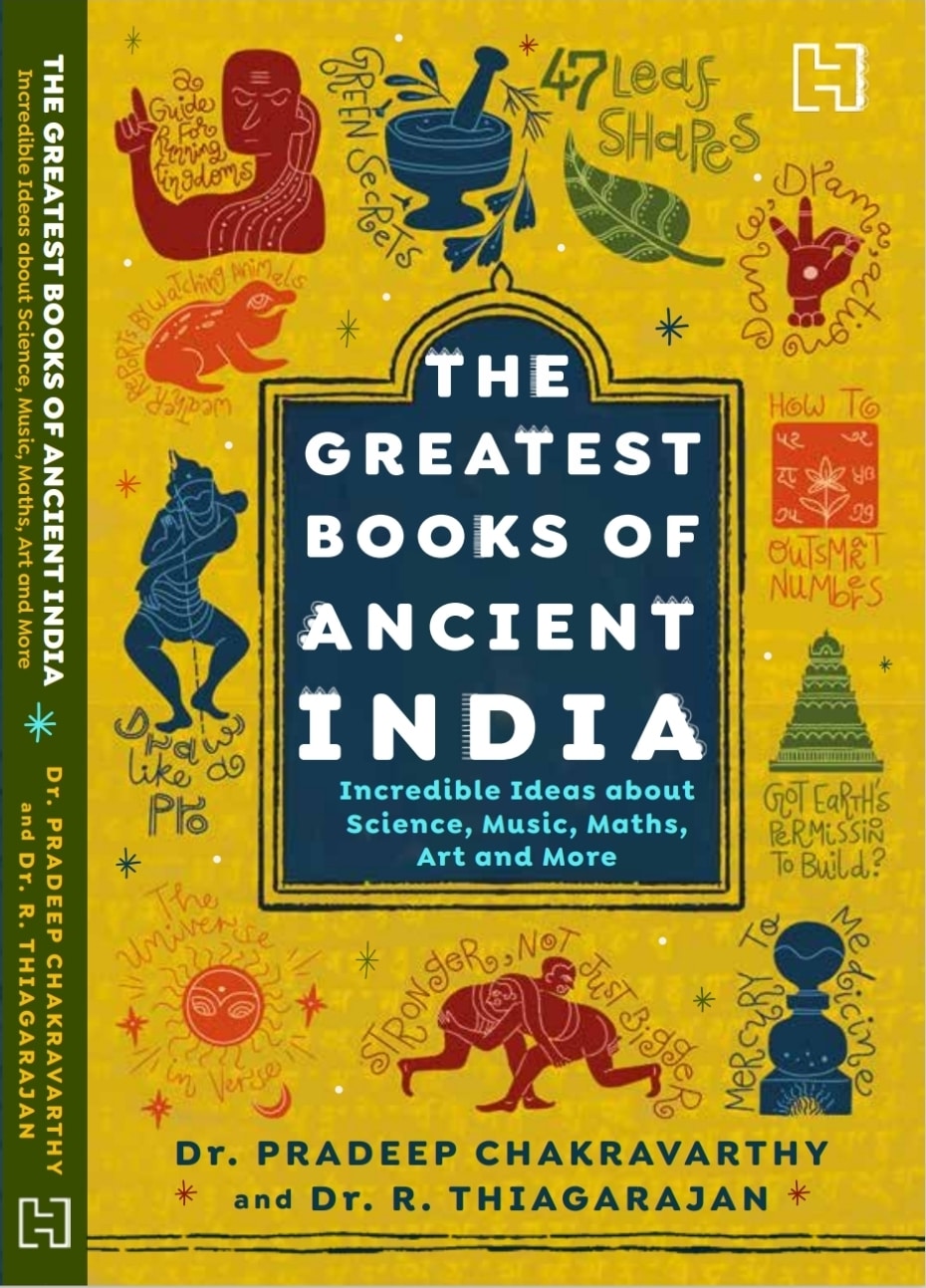
When I co-authored The Greatest Books of Ancient India with Prof. (Dr) R. Thiagarajan and published it with Hachette India in 2026, our goal was simple: to give curious readers — especially younger ones — a clear, vivid introduction to 14 Sanskrit texts that cover subjects ranging from astronomy and architecture to governance, surgery, music, mathematics and wrestling. These are not religious or philosophical texts. They are non-fiction works of extraordinary range and precision, written by some of the finest minds of the ancient world. And almost none of them are well known outside specialist circles.
For Indians of the diaspora — especially those raising children in the United States and elsewhere — this book speaks to a quiet, persistent question: What do I pass on, and how?

What the Book Contains
The 14 texts we cover span centuries and disciplines. Here is a sense of what waits inside:
Aryabhatiya — Written by Aryabhata in 476 CE, this is the text of the man who first proposed that Earth rotates on its own axis — more than a thousand years before it became accepted knowledge in Europe. His system of encoding extremely large numbers as short, memorable words was a feat of mathematical elegance. India’s first satellite, launched in 1975, was named after him.
Lilavati — Perhaps the most beloved of all the books we cover. Written by Bhaskaracharya in the 12th century, it is a mathematics textbook in which every problem is a poem in Sanskrit. Its 277 problems were addressed to a girl — remarkable in an era when girls’ education was rare anywhere in the world. Bhaskaracharya’s work anticipated calculus concepts that Newton and Leibniz would formalise 500 years later.
Arthashastra — Attributed to Kautilya (also known as Chanakya), this is a comprehensive manual for statecraft: how to train a king, manage an economy, run a spy network, handle war and diplomacy, and administer justice. It was considered lost for centuries before a single palm-leaf manuscript was discovered in a Mysore library in 1909. Every management consultant and political strategist who has ever cited Sun Tzu should know Kautilya.
Natya Shastra — Written by Bharata around 200 BCE to 200 CE, this is the foundational text for all of India’s classical performing arts. But it is also, unexpectedly, a guide to writing and storytelling. Bharata lists ten mistakes every writer must avoid — from using needlessly complicated words to faulty rhythm to leaving ideas incomplete. These rules are as useful today as they were two millennia ago.
Mayamata — An architecture handbook from Tamil Nadu, written during the Chola period (11th–13th centuries CE), that describes how to choose a building site by testing soil with seeds and water, how to plan cities and villages, how to build temples to precise mathematical ratios. It opens with a striking declaration: The Earth is our first home, and it is with her permission that any building — home or temple — can be built.
Charaka Samhita and Sushruta Samhita — The two foundational texts of Ayurveda. While Charaka focused on medicine and the nature of disease, Sushruta was a surgeon who described over 300 procedures and 120 surgical instruments. He is widely credited as the originator of rhinoplasty — reconstructive nose surgery. The West rediscovered this technique in the 18th century.
The remaining texts cover chemistry (Rasaratna Samucchaya), encyclopaedic knowledge (Manasollasa), farming (Krishi Parashara), music theory (Sangita Ratnakara), painting (Chitra Sutra), plant science (Vriksha Ayurveda), and — wonderfully — a complete text on wrestling (Malla Purana).
A Word That Travelled the World
One detail from the book that I find especially meaningful for the diaspora: the word bahasa, meaning language in Indonesian and Malay, comes directly from the Sanskrit word bhasha. Cambodia derives its name from the Sanskrit Kambuja. The reach of Sanskrit — and of Indian knowledge — stretches far beyond the subcontinent, woven into the cultures of South-East Asia, Central Asia and beyond.
For Indians who have made their homes in other countries, this is not a small point. The civilisation you carry with you shaped much of the world you live in.
An Extract: On Bhaskaracharya and His Daughter
One of my favourite passages in the book tells the legend of Lilavati. The mathematician Bhaskaracharya, the story goes, predicted that his daughter Lilavati could only be married at one precise auspicious moment. He built a water clock — a vessel with a floating cup designed to sink exactly at the right time. But as a curious Lilavati leaned over to watch, a pearl from her necklace fell into the vessel, blocking its hole. The cup never sank. The perfect moment passed.
Heartbroken, Bhaskaracharya consoled his daughter by naming his famous mathematics book after her. Through hundreds of beautiful mathematical problems, Lilavati’s name became immortal — remembered by students for over 800 years.
Whether or not the story is true, it captures something real about ancient India’s relationship with knowledge: it was not separate from life. It was woven into it.
Why the Diaspora Should Care
The Indian diaspora in the United States is the most educated immigrant community in the country. It has produced scientists, surgeons, engineers, writers, entrepreneurs and policymakers at a rate that is, by any measure, extraordinary. And yet, for many diaspora families, the connection to classical Indian knowledge — the intellectual inheritance, distinct from religious or culinary traditions — has quietly thinned.
This book is one attempt to reverse that. It is written for young readers, but adults will find plenty to discover. It makes no grand claims. It simply opens 14 doors and says: look what was here.
When a child in Houston or New Jersey or the Bay Area reads that an Indian mathematician solved equations 500 years before calculus was “invented” in Europe, or that an Indian surgeon was performing reconstructive procedures two millennia ago, or that an Indian text on governance anticipated nearly every principle of modern statecraft — something shifts. Not pride, exactly. Something quieter and more useful: a sense of where they come from.
That sense is worth protecting. It is worth passing on.
The Greatest Books of Ancient India (Hachette India, 2026) is available in India in paperback, and globally on Kindle. You can find it on Amazon.