Stories That Stay: Why Reading Indian Books Matters for Our Children
April 7, 2026
Some weeks ago while scrolling on Instagram, I saw a video of a guest of honor being welcomed for an event by Delhi Public School, Varanasi. The reel showed a teacher walking the guest of honor into the school, a child welcoming with a flower garland to the stage of a packed auditorium and then a session by the guest with children participating and laughing along. The whole imagery was of welcome and felicitation – something I’d have expected for film/TV/radio personalities and it thrilled me that this was for children’s book author/illustrator Ashok Rajagopalan. And this is just one example of many in India now – where children’s book festivals, school literary fairs, author talks, bookstore events and more are helping spotlight authors and illustrators and building the ecosystem of children’s book publishing in India.
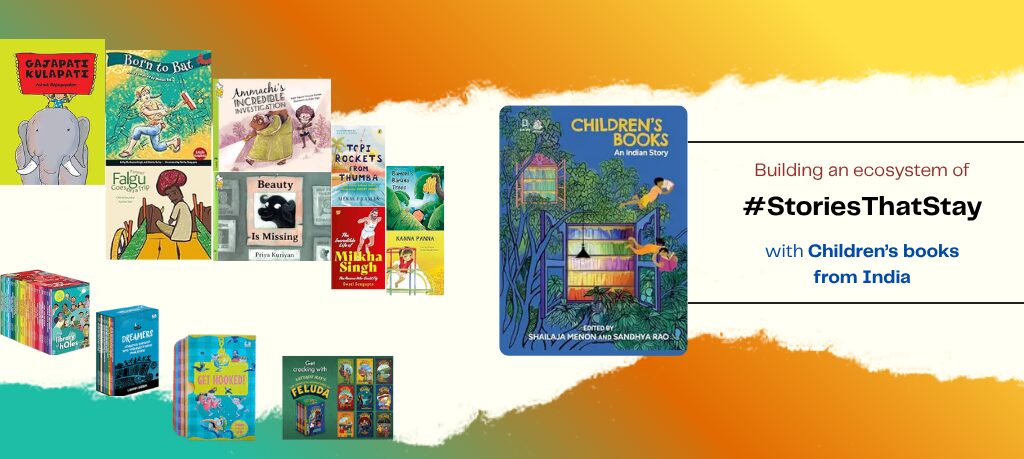
The coming together of an ecosystem for Indian Children’s Books: Is it actually happening?
Over the past two decades, Indian children’s publishing has witnessed a quiet but significant shift from isolated publishing efforts to a more interconnected, if still evolving, ecosystem. Independent publishers such as Tulika, Tara, Katha, Karadi Tales, Eklavya, and Pratham Books have expanded the idea of what children’s books in India can be—foregrounding Indian contexts, multilingualism, illustration-led storytelling, and locally rooted narratives. Complementing the efforts of these Indie publishers, well-established publishing houses such as Penguin, Hachette, Scholastic are also printing a niche set of books written for Indian children. Publishing houses have now built a body of work that reflects Indian childhoods in all their linguistic and cultural complexity. Alongside that, festivals like Bookaroo, Neev Literature Festival, Peek-a-Book Literature Festival and many more across Indian cities are providing a forum for readers, parents, and teachers to connect with authors, illustrators, editors and publishers. Institutional support such as the Sahitya Akademi’s Bal Sahitya Puraskar and similar awards, nonprofit literacy initiatives, school libraries, and international rights exchanges are creating new points of connection between creators, readers, and global markets. The question is no longer whether Indian children’s books exist or matter, but how much or how quickly many loosely connected efforts will mature into a sustainable, well-supported ecosystem that balances cultural and literary thrust with economic viability.
Back to the basics: Why must our children read?
At its core, the case for children’s reading is about how children learn to make sense of the world and their place within it. I say nothing new or unique when I say that reading allows children to experience ideas, emotions, and moral questions at a pace that prompts reflection rather than just consumption. For our children growing up in the American-Indian diaspora, reading offers something increasingly scarce: sustained attention and narrative complexity in a media environment dominated by speed and screens. Even at the risk of overstating, I find value in the reminder that in returning to reading as a healthy habit, we are not resisting modernity but equipping children with the cognitive and emotional tools they need to navigate it.
Basics 2.0: Should children of the Indian diaspora read books by Indian authors
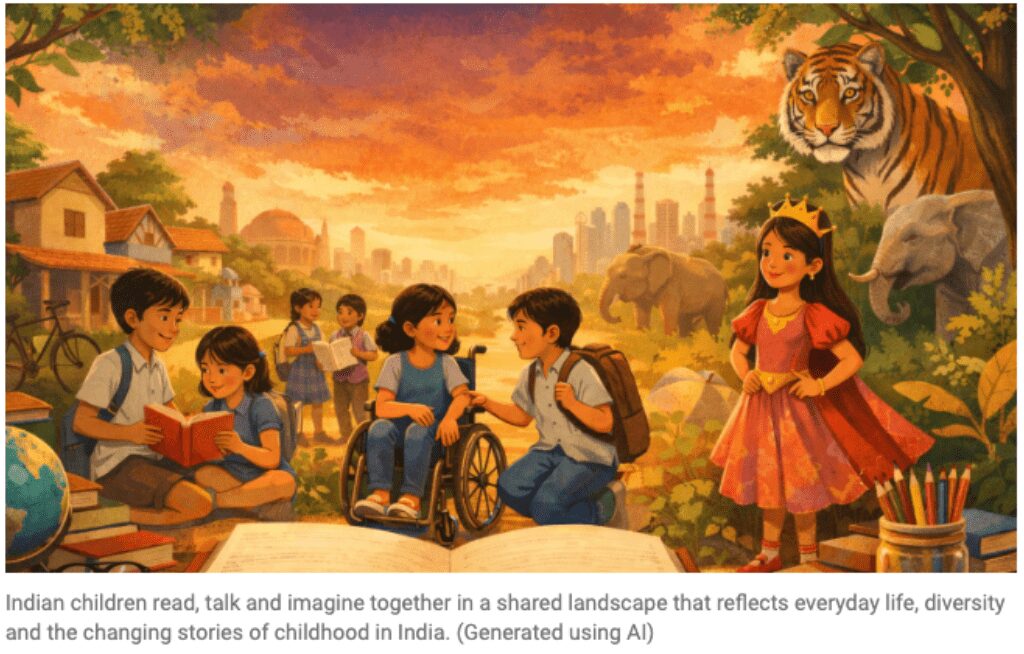
For children of the Indian diaspora, reading books by Indian authors offers something distinct from general reading alone: a chance to encounter India as lived experience rather than as abstraction or inheritance. These stories do not merely “represent” culture; they normalize it by placing Indian names, settings, humor, family structures, and moral frameworks at the center of everyday narratives. For younger children especially, beautifully illustrated picture books help build deeper connections with places they visit, families they meet and festivals that they celebrate. Books by Indian authors can help build a sense of continuity across generations and geographies.
Reading Indian-authored books is not just about nostalgia or cultural obligation—it is about offering children mirrors that feel authentic, and windows that connect them meaningfully to a living, evolving literary tradition. As a prime example, these books complicate identity in healthy ways, presenting India as diverse, contemporary, and internally varied rather than monolithic or frozen in time. For diaspora children navigating questions of belonging, such literature provides quiet reassurance: that their hyphenated identities are not anomalies but continuities. They allow children to see themselves not as cultural outsiders or translators, but as belonging naturally to more than one world.
Lets build this ecosystem further, together
If Indian children’s literature is to truly reach children of the diaspora in the U.S., we must begin to build a small but intentional ecosystem here as well, driven as much by community interest and programs as by existing initiatives. Today, access remains sporadic, appearing at a few literary festivals, through a handful of independent bookstores, or in limited library collections. These efforts matter, but they cannot carry the work alone. What is needed is greater innovation and entrepreneurship from within the Indian community itself: new models for bringing books into homes, pop-up bookstores at cultural events, school and library partnerships, subscription or gifting ideas, and more frequent, child-centered literary programming. When families actively support and participate in these efforts, a virtuous cycle can take shape, where demand, visibility, and access reinforce each other. Building this ecosystem does not require scale to begin with; it requires imagination, initiative, and collective commitment. Through small but sustained efforts, the Indian diaspora can help ensure that books by Indian authors are not occasional visitors, but a living, growing presence in children’s literary lives in the U.S.

Nalini Haridas is the founder of The Burrow Library. A former technologist, Nalini was also previously on the boards of Bangalore-based CENTA and the Kodaikanal International School.
Nalini is a graduate of the Indian Institute of Technology, Delhi where, prophetically, she was Hostel Library Secretary and an active member of the English Debating and Literary Club.
Nalini lives in Kennett Square, PA with her family.