
How Visilant is using artificial intelligence to eliminate avoidable blindness across rural India
When the COVID-19 pandemic swept through India in 2020, rural eye care collapsed almost overnight. Community outreach programs from urban eye hospitals to rural communities were halted due to crowding restrictions. Throughout the country, patients who had vision-threatening conditions or needed sight-saving surgery were too afraid to travel to urban hospitals. This meant that villagers were going blind or remaining blind from cataracts, infections, and ocular injuries, with no way to access care.
It was during these desperate times that Aravind Eye Hospital, one of the world’s largest and most respected eye care institutions, reached out to a team of ophthalmologists and engineers at Johns Hopkins University. They needed a solution that could bridge the gap between rural patients and urban expertise without requiring physical travel.
That collaboration gave birth to Visilant, a nonprofit now using telemedicine and artificial intelligence to bring sight-saving care to communities across India where doctors and clinics remain out of reach.
The Scale of the Problem
The numbers are staggering: 1.1 billion people worldwide live with preventable vision loss. In India alone, cataracts blind millions who lack access to basic eye screening or surgical care. Farmers and laborers in India experiencing occupational injuries are at high risk of corneal injuries and infections, conditions that can cause blindness within hours to days without prompt treatment. Rural patients and their caregivers often must travel hours to urban eye hospitals, often to learn they’d waited too long to receive sight-saving eye care.
Yet the solution, when patients can access it, can be transformative. Cataract surgery is one of the most cost-effective procedures in all of medicine. In a matter of minutes, a skilled surgeon can restore sight to someone who has been blind for years. Corneal transplantation can allow patients with scarring or infections to see again, resume work, and provide for their families. Institutions like Aravind Eye Hospital perform these life-changing procedures with excellent outcomes at minimal cost, serving millions of patients annually.
The missing link is getting patients identified and connected to that care. That’s where Visilant comes in.
How Visilant Works
Visilant is a comprehensive technology platform that decentralizes eye care through three interconnected capabilities:
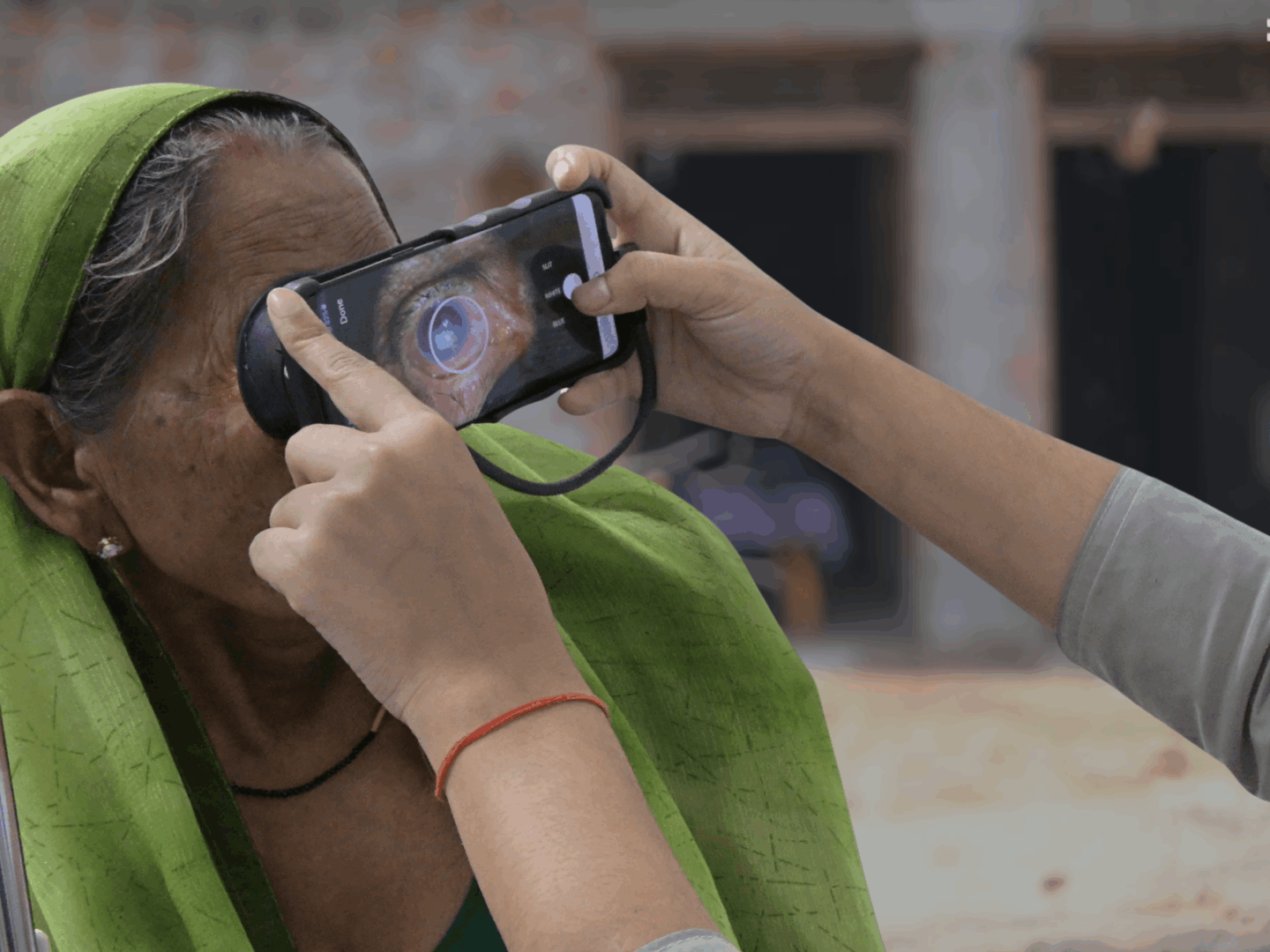
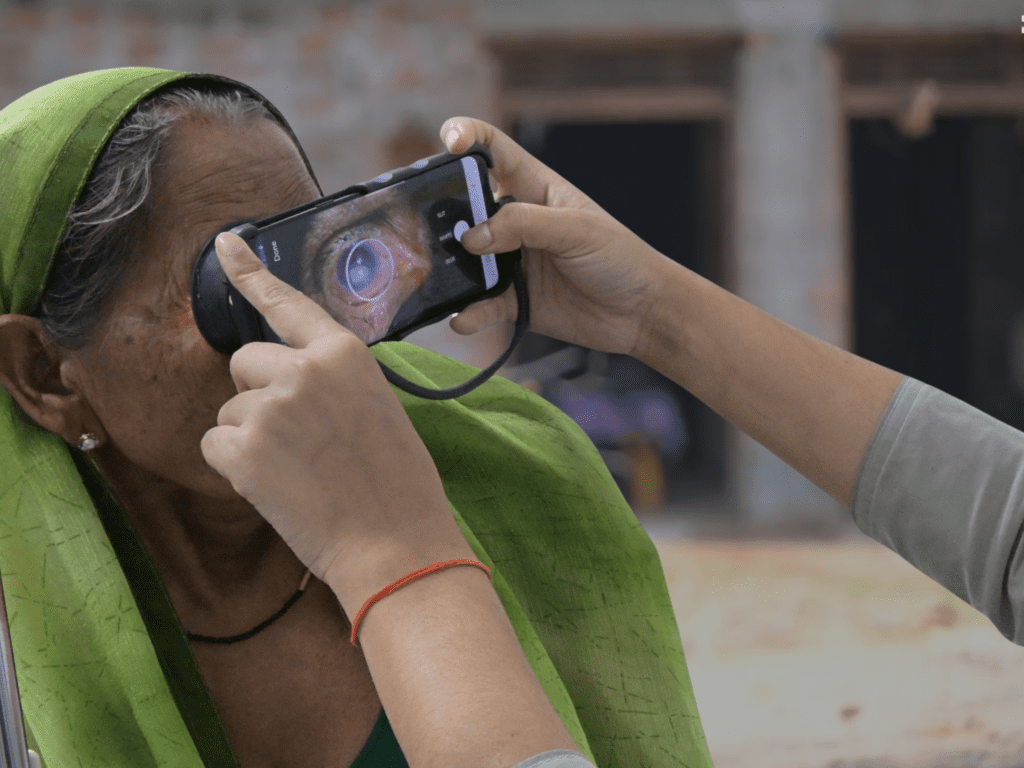
Screen: Community health workers use Visilant’s smartphone-based imaging system and low-cost attachments to capture clinical-grade eye images. Visilant’s hardware is extremely easy to use, enabling people with almost no eye exam training to take diagnostic quality images of the front of the eye.
Interpret: AI models analyze images and patient data to diagnose and triage sight-threatening conditions. The algorithms can diagnose cataract, the leading cause of blindness, with over 94% diagnostic accuracy compared to in-person ophthalmologist eye exams. Other algorithms can diagnose emergencies such as eye injuries and corneal infections with a high degree of accuracy. Crucially, Visilant’s algorithms run offline directly on smartphones, enabling point-of-care diagnosis even in regions without mobile or internet connectivity.
Connect: Telemedicine technology links patients to eye doctors for follow-up care, including sight-restoring surgery, while counseling and referral pathways ensure no one falls through the cracks.
The design philosophy reflects lessons learned from Aravind Eye Hospital, which pioneered making advanced technologies accessible regardless of location or wealth. By training community health workers to perform screening tasks that would otherwise require years of specialized eye care training, Visilant extends Aravind’s highly efficient model through AI. The technology doesn’t just identify disease, but also supports practical clinical decision-making, determining whether a condition is advanced enough to warrant referral for in-person care.
Impact and Recognition
What began as a pandemic response has evolved into an ambitious, growing nonprofit that is increasingly demonstrating real-world impact. Visilant has screened over 30,000 patients across India through cataract camps and vision centers, with technology deployed at leading institutions including Aravind Eye Hospital, Shroff’s Charity Eye Hospital in Delhi and Mohammadi, and SNC Chitrakoot in Madhya Pradesh.
The organization has attracted support from major funders including Google.org (through their Generative AI Accelerator), Microsoft for Startups, the U.S. National Institutes of Health, U.S. National Academy of Medicine, and the Abell Foundation. Visilant has been recognized with multiple MIT Solve awards, including the Health Innovation Award, AI for Humanity Prize, and Crescent Enterprises AI for Social Innovation Prize, and was selected for the 2025 Fast Forward Accelerator, joining an elite cohort of AI-powered nonprofits poised to make a major impact worldwide.
Why This Matters for the Diaspora
Visilant’s founding team brings together complementary expertise in medicine, engineering, and global health. Dr. Nakul Shekhawat, the organization’s Chief Medical Officer and a surgeon-scientist at Johns Hopkins’ Wilmer Eye Institute, was born in Rajasthan and moved to the U.S. at age seven. His commitment to expanding eye care access began during a college trip screening villagers for blinding cataract in the deserts of rural Rajasthan. Jordan Shuff, the Chief Executive Officer, is a biomedical engineer and computer scientist experienced in designing and developing telemedicine systems and leading global health engineering projects. Dr. Kunal Parikh, the President, is a serial inventor and social entrepreneur experienced in building social enterprises and creating and commercializing novel ophthalmic technologies.
Shekhawat sees deep connections between healthcare delivery challenges in both countries. Where a patient comes from too often determines how late they seek care and what their chances of recovery are. That’s been a longstanding issue in India and is increasingly recognized in America as well. The solutions, the team believes, are globally applicable. “Technologies developed in America can be refined, validated, and deployed at scale in India to meet huge unmet needs. What’s particularly exciting is that those same technologies and solutions that have proven their utility in India can be also brought back to America to solve longstanding problems in the U.S.,” Shekhawat says. “This virtuous cycle of innovation ends up being a win-win for both countries.”
For diaspora philanthropists interested in healthcare innovation, Visilant represents a compelling model: proven technology developed at a world-class academic institution, validated in partnership with India’s leading eye care systems, and now scaling with support from major technology and philanthropic partners.

The Vision Ahead
Clear sight empowers people to learn, earn, and live with dignity. For the grandmother in rural Tamil Nadu who can now see her grandchildren’s faces for the first time in years, or for the farmer in Uttar Pradesh who can return to work and support his family after sight-saving treatment for an occupational injury, Visilant is transforming what’s possible.
The organization is actively seeking partnerships with eye hospitals, governments, NGOs, and philanthropists committed to eliminating avoidable blindness. With a model that reduces screening costs while dramatically expanding reach, Visilant demonstrates how AI can be harnessed not just for efficiency, but for equity.
To learn more or support Visilant’s mission, visit visilant.org.